
Table of Contents
What you’ll learn:
How AI systems discover and interpret information about hotels and vacation rentals, what influences their recommendations, and how to make your property easier to understand and match with travelers’ needs.
Key takeaway:
There are NO exact, publicly known algorithms used by ChatGPT, Google Gemini, or Perplexity in every real-world answer that recommends a property. However, research and experience help us understand the signals and processes that can influence their recommendations: how accommodation information is represented, how well it matches a traveler’s intent, and how it is weighed against other available information.
Signals AI systems use when selecting properties
When it comes to AI hotel searches, research shows that really connecting a guest to the right place takes much more than just matching a few search terms.
In a 2025 paper presented at the Association for Computational Linguistics conference, researchers from Booking.com and Leiden University introduced HotelMatch-LLM, a system designed to match natural-language travel queries with hotel information. They clearly state that keywords don’t paint the full picture anymore. AI now reads between the lines – and scans your photo galleries – to connect guests with the actual experience you offer, even if they use completely different words to describe it.
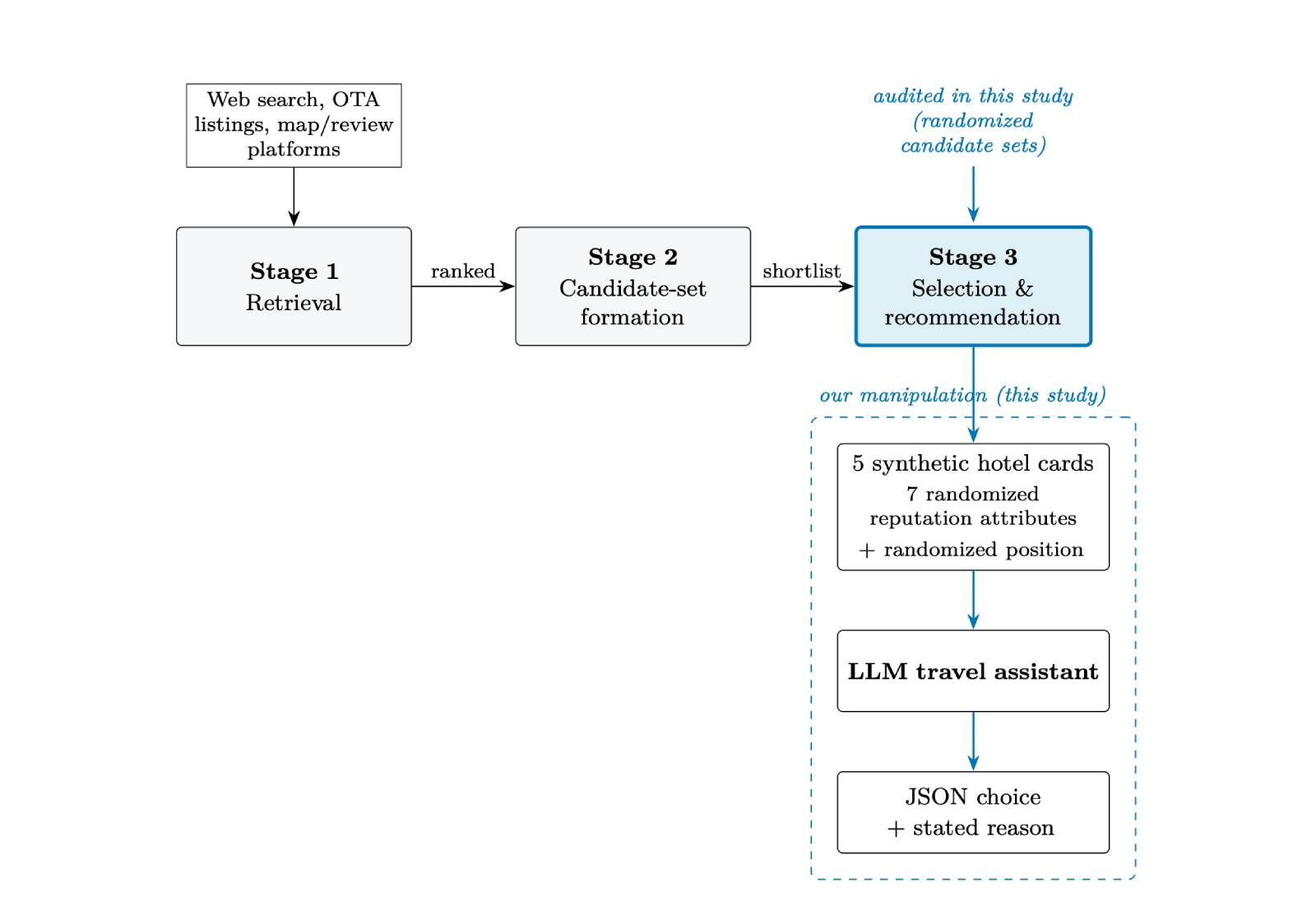
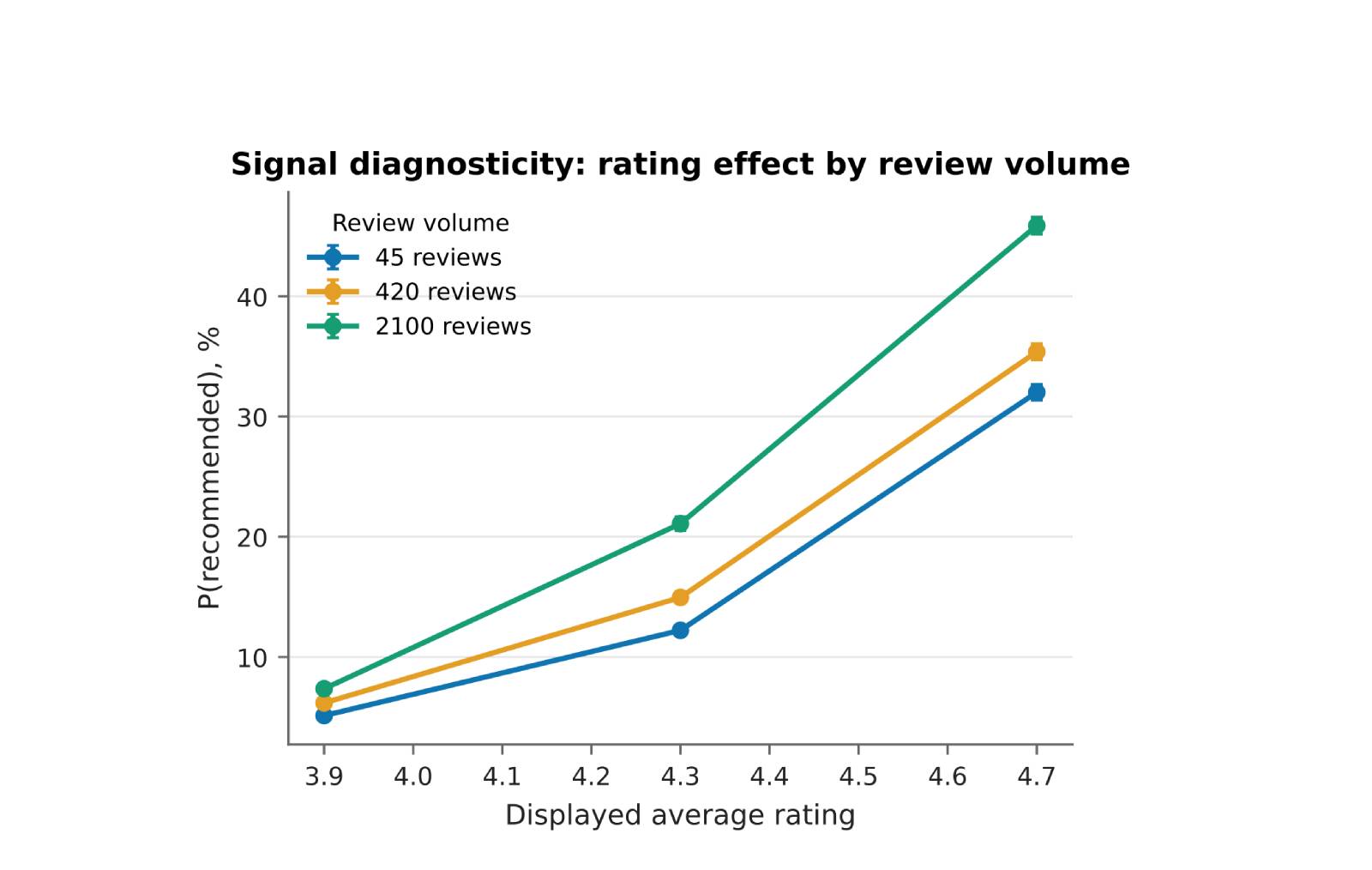
Moreover, in AI-powered accommodation search, being relevant to a traveler’s request and being selected for a recommendation are two different things. A June 2026 preprint, Whose hotel does the AI recommend?, experimentally tested how 12 language models selected among hotel profiles with different ratings, prices, review signals, eco-certifications, and list positions. Guest ratings and price had the strongest effects in the experiment, while review-management responses had no detectable effect; eco-certification and even a hotel’s position in the list also influenced selection. Turns out, what AI says it’s looking at isn’t always what actually drives its choice. In controlled tests, things like price, reputation, and other hidden signals heavily tipped the scales. Their main conclusion: a great description alone won’t save you – AI looks at the full picture.
AI doesn’t just read your website as a wall of text – it breaks it down layer by layer. Your photos tell one story, your room types and amenities another. The clearer and more consistent each piece of that puzzle is, the easier it is for AI to say, “Yes, this place is the perfect match.”
Five levels of AI understanding
Can AI find information about your property?
The property has an online presence that AI systems can access through websites, search indexes, business listings, booking platforms, or other sources.
2. Clarity of information
Can AI understand what the property offers?
The website clearly explains the accommodation type, location, room options, amenities, policies, services, and other essential facts.
3. Structure and machine readability
Can AI identify and interpret individual facts?
Information is organized into meaningful sections, headings, lists, FAQs, and relevant structured data. This can help machines identify specific details rather than interpret everything as undifferentiated text.
4. Consistency and credibility
Can AI find reliable information about the property?
Property details are accurate and consistent across the website, business profiles, booking platforms, reviews, and other relevant sources. Independent mentions and reviews can not just provide additional context but present your hotel or STR as a trusted accommodation.
5. Relevance to traveler intent
Can AI match the property to a particular traveler’s needs?
The available information explains not just what the property has, but also who it suits and why – for example, families traveling without a car, couples seeking a quiet getaway, or guests looking for accommodation near hiking trails.
How these levels work together
Consider a traveler asking an AI tool:
“Recommend a family-friendly hotel near a quiet beach in Mallorca where we can get around without a car.”
- Discoverability: The AI can access information about the hotel. (The website and other online sources can be accessed by relevant crawlers, indexed by search engines, or retrieved through the AI tool’s search and data integrations.)
- Clarity: It can identify the hotel’s location, family facilities, and nearby beach.
- Structure: It can distinguish amenities, transport information, and room details.
- Consistency and credibility: It can find reliable, up-to-date supporting information. The property has good reviews and positive testiomonials across the web. The number of reviews matters, too.
- Relevance: It can determine whether the hotel fits the request and include it in its recommendations. (This depends on how well the property’s documented features match the traveler’s requirements, as well as the AI system’s retrieval and selection processes and the other information available to it.)
These are conceptual levels, not an official ranking or a universal AI evaluation framework. They overlap, and different AI systems use different methods to find and assess information. Even well-presented information cannot guarantee that a property will be recommended.
Concluding: The main things to know
– AI needs to find your property before it can recommend it.
Your website is only one potential source of information. Search indexes, accessible web pages, booking platforms, and other sources can all influence whether an AI system can retrieve details about your accommodation.
– AI recommendations depend on more than your website content alone.
Research into AI-powered hotel search suggests that recommendations can be influenced by how well a property’s features match a traveler’s intent, as well as signals such as price, guest ratings, reviews, and other available information. Clear property descriptions matter, but they are only one part of the picture.
– Price is part of the overall picture AI may use to assess a property’s suitability.
Price sensitivity depended on the traveler’s needs (e.g. price had the greatest influence for the budget-conscious family persona) but the experiment in controlled environment showed that a high price reduced a hotel’s probability of being selected by 30 percentage points, on average.
– Specific details help AI match your property to a traveler’s needs.
Clearly describing amenities, room types, location, transport options, and who your property suits makes it easier to connect your offering with requests such as family holidays near quiet beaches or car-free city breaks.
– Consistent information builds a more reliable picture of your property.
When your website, business profiles, and booking platforms agree on key facts, AI systems have less conflicting information to interpret. This does not guarantee a recommendation, but it helps establish what your property actually offers.