
Table of Contents
What you’ll learn:
You’ll learn how travelers move between OTAs, Google, property websites, and different devices before choosing where to book. You’ll understand the Billboard Effect, Google’s role in comparing and verifying accommodation, and why your direct website matters even when guests first discover your property elsewhere.
Key takeaway:
Where a guest discovers your property does not necessarily determine where they book. Travelers may find you on an OTA, check your location and reviews on Google, and visit your website before deciding. Each interaction can influence that decision. Your direct website needs to make it easy to understand your offer, trust your business, and complete a reservation.
How the modern booking funnel actually looks
Years ago, travel search was relatively linear. A traveler would decide on a destination, search for accommodation, look at a few options, and book.
Today, planning a trip is a chaotic, non-linear process that jumps across devices and platforms. According to Expedia Path to Purchase research, travelers view an average of 141 pages of travel content in the 45 days leading up to a trip.
A 2026 report by McKinsey & Company takes this further, describing the modern journey not as a funnel, but as a series of “travel orbits.” They found that the average traveler interacts with up to 65 digital touchpoints before making a decision, up from 45 in 2018.
Because of this massive volume of choices, the path is highly iterative. Roughly one in three actions a traveler takes actually moves them backward in their decision process (for example, abandoning a booking page to go back and research a different neighborhood).
Here is how the fragmented search and planning journey usually looks now:
| 1. Inspiration & Broad Discovery | The traveler decides on a destination via social media (Instagram, TikTok), word of mouth, or broad conversational queries with AI tools (ChatGPT, Gemini). |
| 2. Filtering & Shortlisting | They move to an Online Travel Agency (OTA) like Booking.com, Airbnb, or Expedia, or use Google Travel. They rely on these platforms because of their powerful filters, narrowing down options by price, specific neighborhoods, or other factors to create a shortlist of 3 to 5 properties. |
| 3. Verification (The Cross-Check) | This is the critical stage. The traveler leaves the OTA and turns to Google. They search for the specific property names on their shortlist to check Google Maps for the exact location, read third-party reviews, and look for the official direct website to see better photos or find a better rate. |
| 4. Conversion (The Booking Decision) | The traveler finally books. They will choose the channel that offers the best perceived value, the lowest friction, or the most trust. |
There is a lot of research that highlights how complex this behavior has become, including:
| Research | Key finding | Why it matters to you |
|---|---|---|
| Expedia Group – Path to Purchase | After visiting a hotel or airline website or app, about a quarter (24%) of travelers are most likely to visit an OTA next. After visiting an OTA, most travelers (89%) visit another travel website, such as an airline, hotel, or meta travel website. (Expedia Group) | Your property needs to make a consistent impression across multiple platforms (OTAs, Maps, Direct site) because guests will investigate you everywhere before committing. |
| McKinsey – Winning Hearts in an Age of Infinite Travel Choices (2026) | Travelers navigate up to 65 digital touchpoints, and roughly 1 in 3 actions moves them backward in the planning process. (McKinsey) | The booking journey never stops. Guests constantly re-evaluate options, meaning your direct site must remain visible to catch them as they loop back and forth. |
| Phocuswright – Europe Consumer Travel Report (2026) | OTAs have overtaken general search as the primary planning resource, and travelers prioritize a “quick and easy booking process” (especially in the U.K.). (Phocuswright) | OTAs are the undisputed starting point for many guests. If your direct booking process isn’t as fast and frictionless as an OTA, you will lose the guest when they try to book directly. |
| SiteMinder – Latest trends in the hotel industry for 2026 | 26% of travellers now start their hotel research on platforms like Booking.com, surpassing Google and other search engines (21%) for the first time in industry history. And 18% of travellers who start their search on an OTA ultimately book directly with hotels, up 3.3 percentage points as guests seek control and better service. (SiteMinder) | OTAs now serve as research starting points, not just final booking destinations. Nearly one in five OTA researchers escape the platform to book directly, looking for better control and service. Your direct website must be ready to intercept them when they come looking for you. |
The Billboard Effect: Why OTAs drive direct bookings
First coined by researchers at Cornell University, the “Billboard Effect” is a hospitality marketing term describing the massive boost in direct website bookings a property gets simply by being listed on an Online Travel Agency (OTA).
Think of an OTA like a giant digital billboard on a busy highway. The billboard itself doesn’t sell you the product right there. It just makes millions of people aware that your property exists.
With OTAs overtaking traditional search engines as the primary planning tool, property owners often view them as expensive enemies that steal direct bookings. In reality, travelers use OTAs as search engines.
Expedia’s Group Path to Purchase research shows that most travelers use OTAs for research to compare options and availability, regardless of where they book. Once they find your property, they open a new tab and Google your brand name.
If your website is properly optimized, appears at the top of Google for your own brand name, and offers a frictionless experience that cures their “comparison frustration,” you can intercept that booking. The OTA did the heavy lifting of discovery (the billboard); your website executes the conversion.
Ready to capture those Billboard Effect bookings?
Driving traffic from OTAs to your website only works if your site is equipped to accept direct, commission-free reservations without adding more friction to the traveler’s journey.
The MotoPress Hotel Booking plugin turns any WordPress website into a fully functional booking engine. Sync your calendars with OTAs, set custom rates, and offer the direct-booking perks guests are actively searching for.
The Google Ecosystem dominates the middle of the funnel
With travelers overwhelmed by infinite choices and 45% frustrated by trying to compare data, Google has positioned itself as the ultimate travel hub to reduce that friction.
When a guest searches for your property after finding it on an OTA, they are immediately met with:
- Google Business Profile: Showing your photos, address, and quick links.
- Google Maps: Where guests check your proximity to the beach, transit, or downtown.
- Google Hotel Center (Metasearch): Displaying a price comparison module that pits your direct website rate against the rates offered by OTAs.
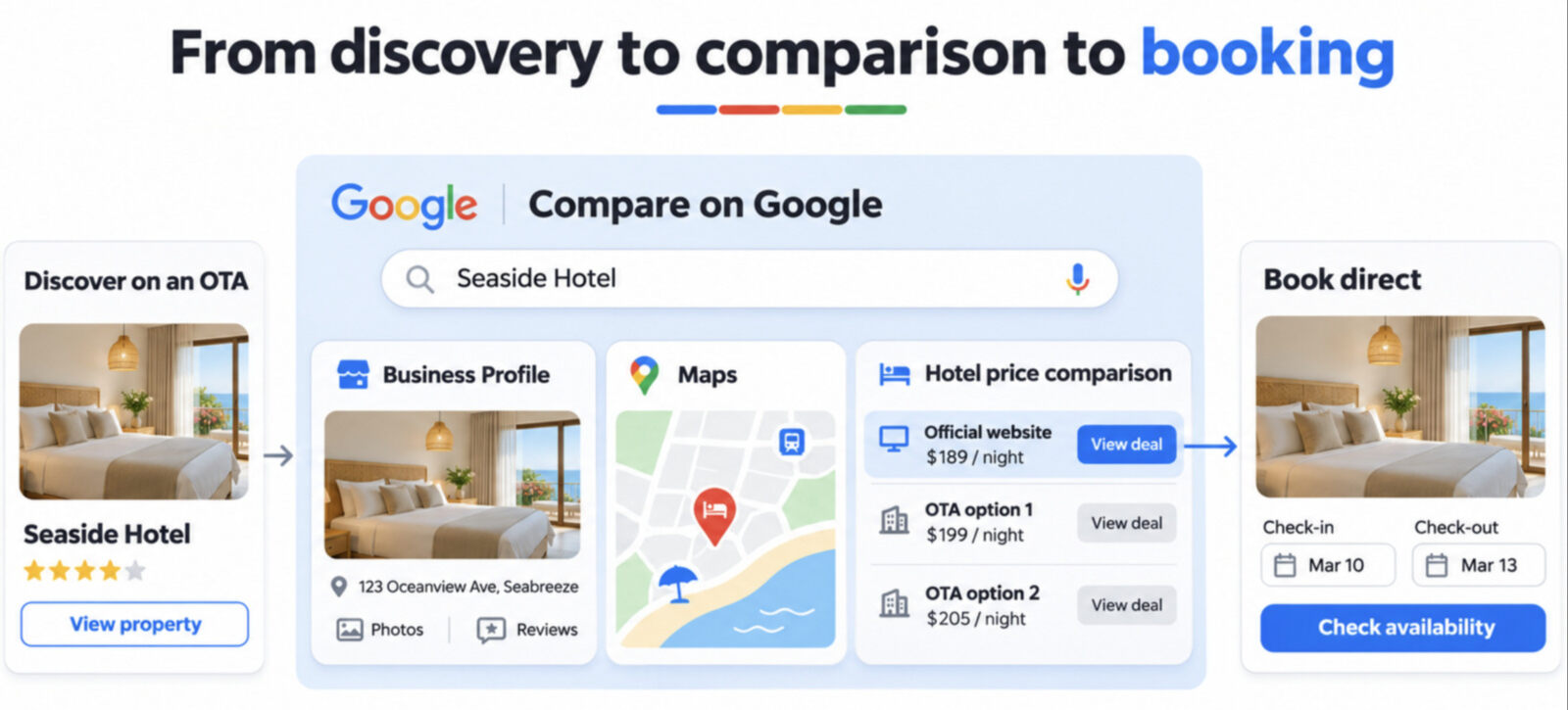
If your direct booking link isn’t visible in the Google ecosystem, or if your Google Business Profile is incomplete, the traveler’s journey is interrupted, comparison frustration sets in, and trust is broken.
Related Guide:
- Audit your website’s current Google visibility
Mobile Discovery vs. Desktop Booking
Another vital aspect of modern search behavior is cross-device usage. According to the latest statistics, although mobile accounts for around 60% of online travel traffic, desktop accounts for about 62% of sales. So, even though travelers do more research on mobile, they still use desktop to book.
Travelers scroll through options while commuting, waiting in line, or sitting on the sofa. However, when it comes to the actual transaction, especially for expensive multi-night stays or group trips, many travelers still prefer to switch to a desktop or laptop computer. They want a larger screen to ensure they are picking the right room, double-checking the dates, and securely entering credit card details.
This means your website must provide a seamless experience that allows users to easily find your property again when they switch devices.
Concluding: The main things to know
– The booking journey involves repeated comparisons.
Travelers can move between inspiration, research, shortlisting, and booking several times. Someone who leaves your website may still be considering your property while checking transport, discussing plans, or comparing cancellation policies. Understanding this behavior helps you see your website as part of a wider decision process.
– OTAs can introduce guests who later book directly.
An OTA listing can help someone discover your accommodation without becoming the final booking channel. This is the opportunity behind the Billboard Effect. However, exposure alone does not secure a direct reservation: guests still need to find your official website and see a clear reason to book there.
– Google helps travelers connect discovery with confidence.
After finding a property, guests may use Google to locate its official website, examine its surroundings, read reviews, or compare booking options. These checks help them decide whether the accommodation matches their expectations. Clear, consistent property information across these touchpoints supports that evaluation.
– Your direct website needs to resolve the questions that remain.
A visitor arriving from an OTA may already know your property’s name and general appearance. They may now want clearer room details, the total price, cancellation terms, or confirmation of a particular amenity. Your website’s value lies in answering those questions and making the next step straightforward.
– Both mobile and desktop experiences matter.
Guests may research on one device and return on another, while others complete the entire journey on their phone. Accommodation details, availability, prices, and booking functions should be easy to use on either screen. A difficult mobile experience can affect consideration long before a guest reaches the payment stage.
– Direct bookings depend on the complete offer and experience.
Being discovered is only part of the process. Guests also weigh suitability, price, flexibility, trust, and ease of booking. A clear offer and a straightforward reservation process help turn interest generated across other platforms into a booking on your own website.