
Table of Contents
What you’ll learn:
You’ll learn how organic website results, paid search, and Google Maps differ in visibility, cost, control, and purpose. You’ll understand the advantages and limitations of each, where hotel ads and free booking links fit, and why their value depends on the suitable bookings they help generate.
Key takeaway:
Organic search, paid search, and Google Maps offer different ways for guests to discover and evaluate your accommodation. They can complement one another, but the right mix depends on your property, eligibility, demand, and resources. More exposure becomes valuable when it connects suitable guests with a stay they can confidently book.
The Battle for the Search Results Page
When a traveler searches for accommodation today, they do not just see a simple list of websites. They see a battlefield.
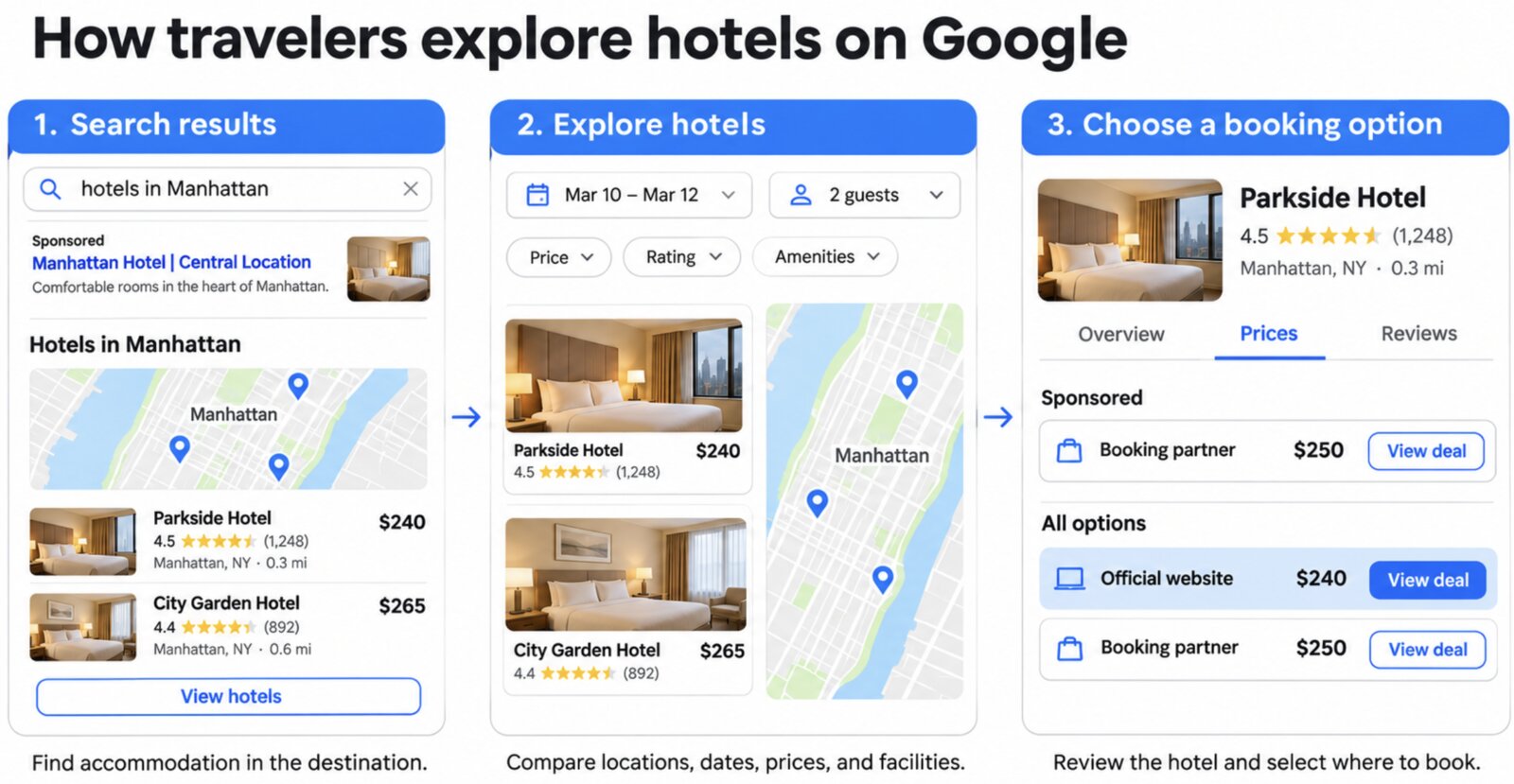
At the very top of the screen, they see Paid Search (sponsored text ads and Google Hotel Ads). Directly below that, they see the Google Maps Local Pack (a visual map interface highlighting three specific properties). Finally, below the map, they find the Organic Search results (the traditional unpaid links).
According to 2026 industry data from AtlasPerk, organic traffic volume for travel queries is roughly 5x higher than paid search. However, because paid ads and the map pack dominate the very top of the mobile screen, properties that only invest in organic SEO often lose bookings to competitors (or OTAs) who pay to be seen first.
To maximize your direct bookings, you must understand how to leverage all three surfaces.
The difference at a glance
One distinction comes first: organic and paid describe types of placement; Google Maps is a platform where unpaid results and advertising can both appear.
In this lesson, “organic search” means unpaid website results, while “Maps visibility” means the unpaid local presence of an eligible accommodation business.
| Question | Organic website results | Paid search | Google Maps and local results |
|---|---|---|---|
| What does the guest see? | A link to a relevant website page | A result identified as advertising | A listing with location, photos, reviews, and business details |
| What determines visibility? | Relevance, quality, and other search signals | Advertising auctions, including bids, quality, and context | Local relevance, distance, and prominence |
| What do you pay Google? | No charge for an organic click | Search ads generally charge per click | No advertising charge for the unpaid listing |
| Where does the investment go? | Content, website quality, maintenance, and SEO | Ad spend, campaign management, and the website experience | Business information, reputation management, and supporting content |
| How much control do you have? | You control your pages, but not their positions | More control over targeting, budget, and timing; no guaranteed position | You manage eligible business information, but cannot choose the unpaid ranking |
| What is it especially useful for? | Answering questions and attracting ongoing discovery | Reaching selected searches or markets while a campaign runs | Helping guests compare location, reputation, and suitability |
| Main limitation | Visibility takes time to develop and can change | Traffic costs money whether or not it converts | Eligibility, location, and competition limit visibility |
Organic search: discovery through your website’s content
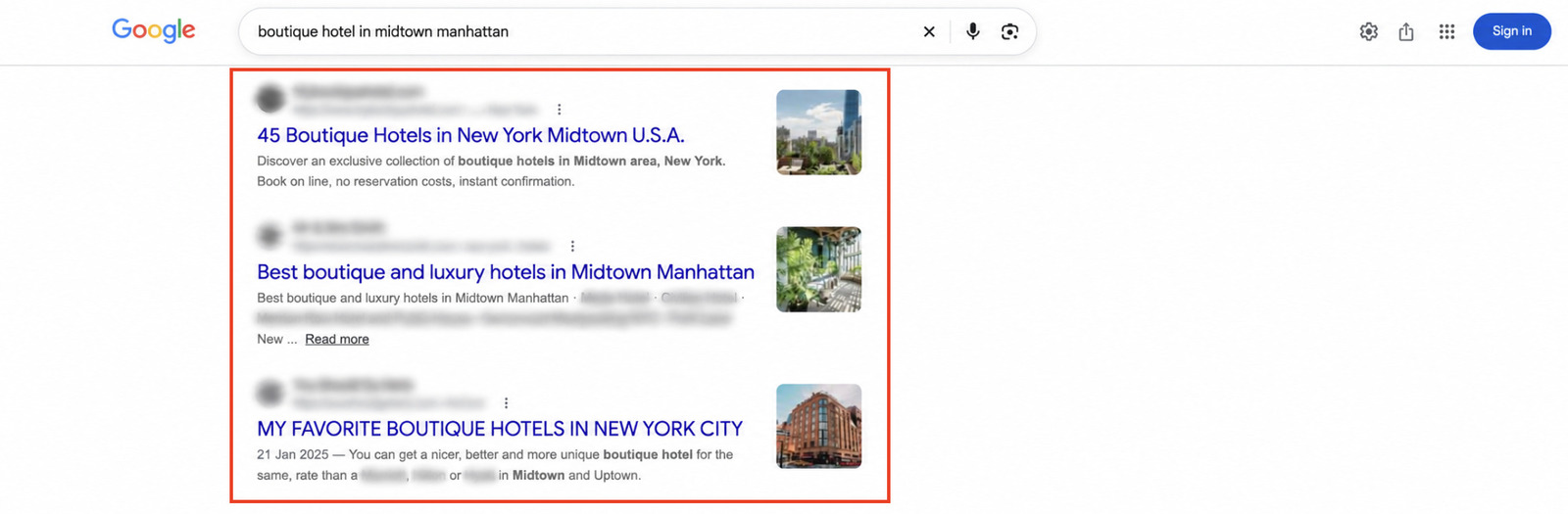
Organic results are unpaid links Google selects in response to a search. They can lead to your homepage, an accommodation page, a location page, or a useful guide.
Where it fits: Organic search is useful for building a lasting source of relevant discovery, especially when your pages address needs your property can meet.
Advantages
1. It can support several stages of the booking journey.
Your website can help guests understand the destination, compare accommodation, and investigate a property they already know.
2. Useful pages can continue attracting visitors.
An accurate accommodation page or helpful local guide may remain valuable over time. Each organic visit does not require another payment to Google.
3. You control the information after the click.
Your website provides space for layouts, photographs, policies, and explanations that help guests assess your property.
Limitations
1. Results take time and are uncertain.
Google needs to discover and evaluate content, and competitors may already have strong visibility. SEO offers no guaranteed date or position.
2. “Unpaid” does not mean cost-free.
Writing, photography, technical maintenance, and professional support require time or money.
3. Prominent ranking does not guarantee a visit.
Maps, advertising, hotel features, and AI answers can compete for attention on the results page.
4. Traffic may be poorly matched to your accommodation.
A popular destination guide can attract readers who have already booked elsewhere or are only researching a day trip.
Related Guides:
- Build a keyword map for your website
- Optimize your accommodation/property pages for search
Paid search: advertising around selected searches
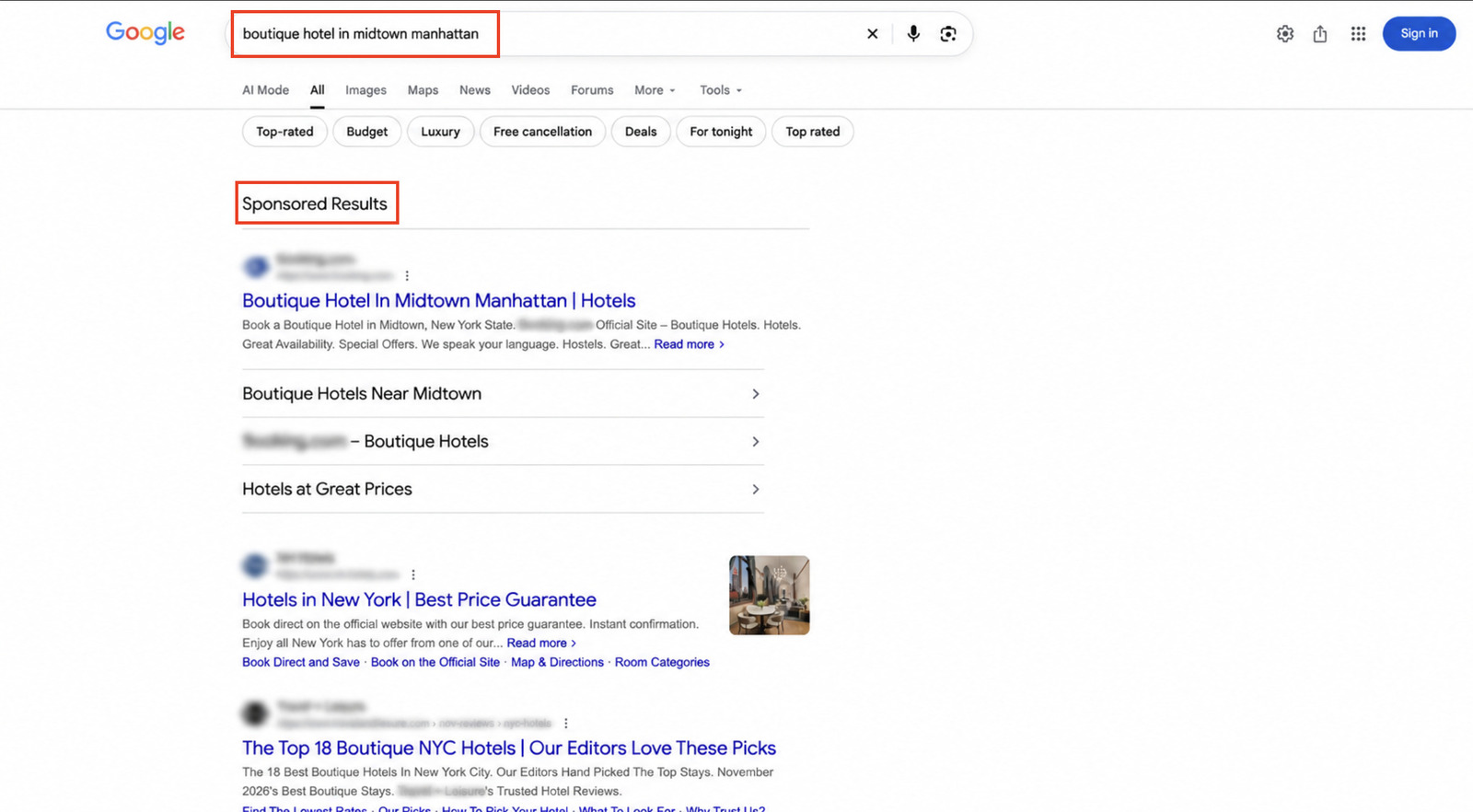
Paid search lets an accommodation business compete for advertising placements related to travelers’ searches.
A hotel might advertise around its own name, a relevant location, or an accommodation requirement. An ad then directs the visitor to a chosen page.
Google Search ads generally use cost-per-click pricing: you pay when someone clicks, whether or not they book. This charging model is different from a bidding strategy, which determines how bids are managed toward a goal.
Ad placement depends on more than the highest bid. Google also considers ad and landing-page quality, search context, and other auction factors.
Where it fits: Paid search can support a defined commercial opportunity when the likely booking value justifies the acquisition cost. It cannot compensate for an unsuitable offer.
Advantages
1. It can create exposure sooner than waiting for organic growth.
An eligible, approved campaign can compete in auctions while a newer website is still developing its unpaid visibility.
2. It offers more control over exposure.
Campaign settings allow choices about budget, targeting, and timing. This can support a particular market or booking period.
3. It can direct attention to a specific offer or stay.
For example, an apartment operator might advertise a relevant longer-stay offer to people searching for that type of accommodation.
Limitations
1. Clicks are a cost, not a booking guarantee.
Visitors may compare prices, discover unsuitable dates, or leave without reserving.
2. The paid exposure depends on campaign delivery.
Pausing advertising stops new ad exposure from that campaign, although people reached earlier may still return later.
3. Poor targeting and weak booking experiences can waste spend.
Advertising to unsuitable visitors or sending suitable visitors to an unclear page limits the value of the traffic.
4. An attributed booking is not always an additional booking.
Someone clicking an ad for your exact property name may already have intended to book directly. Attribution identifies a recorded path; it does not by itself prove the ad caused the booking.
Related Guides:
- Identify whether paid search is appropriate for your property
- Build a small Google Ads campaign around high-intent searches
Google Maps: discovery through location and reputation
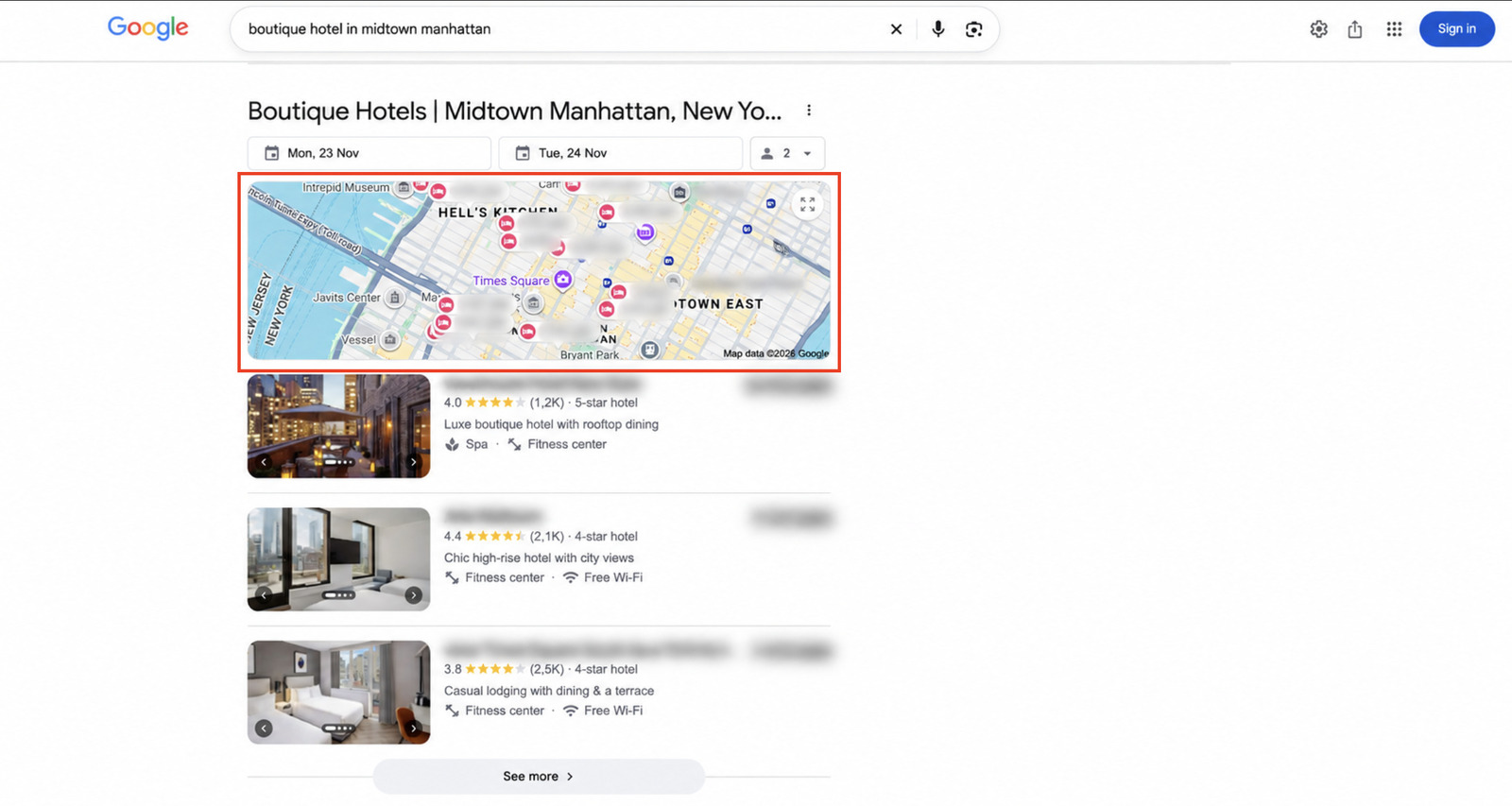
Google Maps and local results help travelers explore businesses in relation to a place. Guests can assess location, photos, reviews, and available business details before visiting a website.
A traveler might search near a conference venue, compare hotels around a station, or inspect a property they first found on an OTA.
Google says unpaid local ranking is mainly based on relevance, distance, and prominence.
Where it fits: Maps is particularly useful when a guest’s decision depends on where an eligible business is located and how it is perceived.
Advantages
1. It makes location easier to evaluate.
Guests can see the property in relation to transport, venues, attractions, and other accommodation.
2. It brings reputation into the comparison.
Reviews and photographs help travelers understand what staying there may be like.
3. It supports decisions beyond the website visit.
A guest may call, request directions, explore booking options, or save the property for later.
4. An eligible business can have an unpaid presence.
Advertising is not required to appear in local results, although visibility is not guaranteed.
Limitations
1. You cannot choose your proximity to the search location.
A property farther from the area being considered may be less suitable for that search, regardless of website quality.
2. Google controls the interface.
Your listing appears within Google’s comparison environment, alongside other businesses and potentially other booking providers.
3. Interactions do not all represent new demand.
A directions request may come from someone who has already booked. A phone call may concern an existing reservation.
4. Not every accommodation qualifies for a Business Profile.
Google lists individual vacation homes as ineligible. An eligible rental agency or office is a different case. A vacation rental’s website can still appear in organic results, and Google has a separate vacation rental integration route.
Why reviews matter to the guest
Expedia Group’s 2025 Traveler Value Index reported that three-quarters of travelers were willing to pay more for lodging with better reviews. This is evidence about stated traveler preferences, not a measurement of Google Maps ranking or guaranteed willingness to pay at your property.
It helps explain why location alone may not settle the decision: guests also want confidence in the experience.
Where Google Hotels and free booking links fit
Accommodation search includes an extra layer: travelers may compare prices and booking providers for a hotel.
Hotel Ads are paid placements associated with hotel search. Free booking links are unpaid options that can direct guests to a booking website. These can appear in Google’s hotel experiences across Search and Maps.
| Placement | What it helps the traveler do | Important distinction |
|---|---|---|
| Organic website result | Visit a relevant webpage | Selected through web search systems |
| Hotel Ad | Consider an advertised hotel booking offer | Selected through an advertising auction |
| Free hotel booking link | Visit an unpaid booking offer | Google does not charge for the click |
| Business Profile website link | Visit the business’s website | Different from a date-specific room-price offer |
The Direct Booking Website: How they work together
A successful direct booking strategy does not choose between these three channels; it utilizes them together to cover the entire guest journey.
| Channel | The Traveler’s Mindset | Your Primary Goal |
|---|---|---|
| Organic Search | Dreaming & Planning. They are researching destinations, amenities, and local guides. | Provide helpful answers. Build trust and brand awareness so they remember you later. |
| Google Maps | Verifying Location. They are checking the neighborhood, reading reviews, and ensuring proximity. | Prove authority. Ensure your photos are high-quality, reviews are answered, and your map pin is deadly accurate. |
| Paid Search | Ready to Book. They are actively comparing prices and searching for your specific brand name. | Win the click. Defend your brand name from OTAs and offer a direct rate that matches or beats third parties. |
The shared business question is: does this visibility contribute to suitable, profitable stays?
A channel generating fewer visitors can be valuable if those visitors have a strong fit with the accommodation. A channel generating many clicks can disappoint if dates, price, or facilities do not meet expectations.
Related Guides:
- Audit your website’s current traffic [GA4]
- Optimize your homepage for your main location and property type
Give every interested visitor a clear path to book
Whether guests find you through organic search, an ad, or Google Maps, your website needs to help them choose accommodation and make a reservation.
MotoPress Hotel Booking brings availability search, accommodation listings, and online reservations to your WordPress website. Guests can explore suitable options and book directly, while you manage rates, availability, and reservations in one place.
Concluding: The main things to know
– The three options provide different kinds of visibility.
Organic website results connect searches with relevant pages. Paid search provides advertising opportunities with control over targeting, timing, and budget. Maps helps travelers evaluate location, reputation, and business details. Maps can also display advertising, so the platform itself should not be confused with an exclusively unpaid channel.
– Organic visibility can provide lasting value, but it requires ongoing investment.
Useful accommodation pages and local information can continue attracting relevant visitors without a charge for each organic click. Creating and maintaining that content still takes resources, and positions can change. Its value depends on whether the people it attracts have a reason to consider your accommodation.
– Paid search offers control over campaigns, not guaranteed bookings.
Advertising can help you reach selected searches sooner, but each paid click carries a cost even when the visitor leaves without reserving. Targeting, availability, the offer, and the booking experience all influence the outcome. A booking attributed to an ad also needs careful interpretation: the guest may already have intended to book directly.
– Maps helps guests assess both convenience and confidence.
Location, photographs, reviews, and business information help travelers decide whether a property suits their plans. However, distance and eligibility place limits on this channel. An individual vacation rental should not assume it qualifies for the same Business Profile presence as a hotel or an eligible rental agency.
– Guests can use any of these channels at several points in their journey.
Organic visitors may be ready to reserve, paid visitors may still be exploring, and Maps users may already have a booking. The channel alone does not reveal intent. The search, the information viewed, and the action taken provide a more useful picture of what the guest needs.
– The right channel mix should support suitable, profitable stays.
Not every property needs to invest equally in all three options. A smaller number of relevant visitors can be more valuable than a large volume of poorly matched clicks. Across channels, your website needs to explain the accommodation clearly, show applicable prices and conditions, and make checking availability and booking straightforward.