
Table of Contents
What you will create: An improved accommodation or destination page, a plan for connecting related pages, and a repeatable content quality checklist.
In this practice, you will:
- Reshape accommodation and destination pages around real traveler questions.
- Make important information clear without keyword repetition or lengthy introductions.
- Add verified details that distinguish your property from generic listings.
- Organize accommodation, destination, and event content into a logical structure.
- Review AI-assisted content so it adds real value rather than repeating what’s already available.
- Check content quality and track visibility over time.
Your website must do more than describe your property – it should show guests why it’s right for them and what to explore nearby.
While no format guarantees AI feature inclusion, making your content clear, useful, conversational, and verifiable boosts discoverability across both traditional and AI search.
1. Start with one page and one traveler need
Don’t attempt to rewrite your entire website at once. Choose one accommodation page, destination guide, or event page where better information could help travelers discover or evaluate your property.
Step 1.1. Choose a real traveler question
Review guest messages, reviews, booking inquiries, and Google Search Console queries. Choose a question that matters to your audience and that your property or local knowledge can genuinely help answer.
- Can I stay near the beach without renting a car?
- Which facilities make this apartment suitable for a family with a toddler?
- What can guests do nearby on a rainy day?
- Where can visitors find local markets or events during their stay?
Step 1.2. Write a short page brief
Before editing, record the page’s audience, main traveler needs, verified differentiators, important limitations, destination context, and the action you want visitors to take.
| Item | Example working brief |
|---|---|
| Main audience | Couples and small families planning a beach holiday |
| Main traveler needs | Understand the accommodation, beach access, parking, nearby amenities, and whether a car is necessary |
| Verified differentiators | Two bedrooms, private balcony, outdoor dining table |
| Important limitations | No private parking; paid public parking nearby |
| Main action | Check availability and book directly |
This brief helps you decide what belongs on the page and what information you still need to verify.
Note: LLM models are very sensitive to “exact match phrasing” in text. People in chats use different phrases, so the more coverage, the higher the chances that your website will be cited.
2. Structure sections so they are easy to understand
Retrieval methods differ between AI systems, and their exact workings are not public across all platforms. You don’t need to split every page into tiny text fragments. Organize the page naturally so people can find, understand, and use each section.
Step 2.1. Give the page a clear structure
In WordPress:
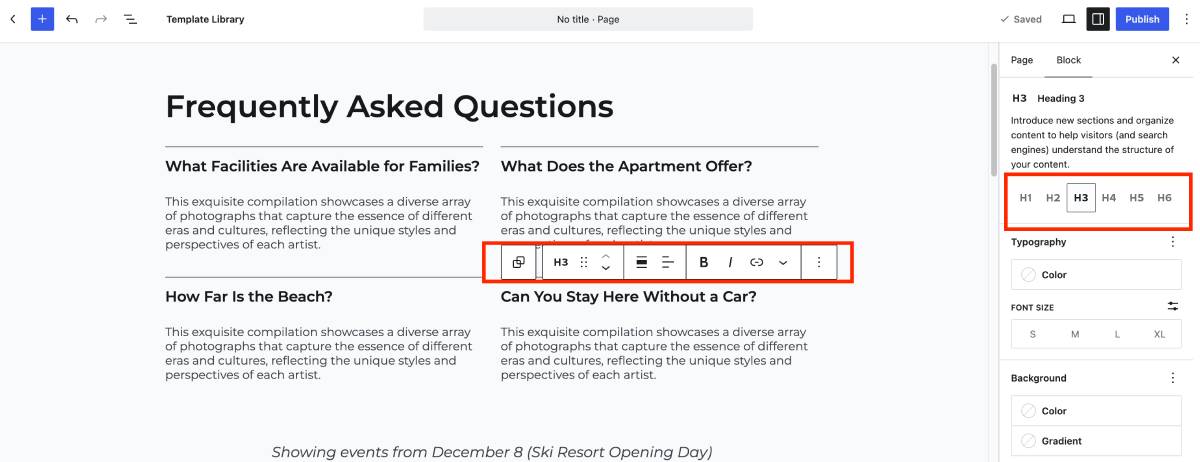
- Use one clear H1 that identifies the page’s main topic.
- Divide the content into meaningful H2 sections.
- Use H3 headings for related details under a larger section.
- Use lists for several facilities or recommendations and tables for comparisons.
- Keep important information in normal page text, not only inside images.
For example, an accommodation page might use headings such as “What Does the Apartment Offer?”, “How Far Is the Beach?”, “Can You Stay Here Without a Car?”, and “What Facilities Are Available for Families?” You don’t need to turn every heading into a question; use a question when it naturally matches a traveler’s concern.
Step 2.2. Make sections understandable on their own
Start each section with its main point, then add the details needed to understand it. Avoid vague references such as “it,” “nearby,” and “close by” when the reader needs a specific place or distance.
Less useful: “The beach is close by, and it is easy to get there. There are also several restaurants nearby.”
More useful: “The apartment is approximately [verified distance] on foot from [beach name]. The walking route follows [brief route description]. Restaurants are available around [verified location], approximately [distance or walking time] away.”
Don’t force every section to fit a specific sentence count. Include enough context to answer the question without padding the content.
3. Use headings that reflect real traveler questions
Guests often describe the situation they want to solve rather than search only by accommodation type or amenity. Collect wording from guest messages, reviews, Search Console queries, relevant travel forums, and realistic prompts tested in AI search tools.
| General topic | Natural traveler questions |
|---|---|
| Location | Can I walk to the beach? Is the town centre within walking distance? |
| Transport | Can I get around without renting a car? Is public transport practical? |
| Families | Is this rental suitable for a toddler? Is a cot available? |
| Remote work | Can I work remotely from the property? Is there a dedicated workspace? |
| Outdoor facilities | Does the apartment have a private balcony? Is there a shaded place to eat outside? |
Choose the most useful wording for each heading and answer it accurately. You don’t need separate pages for every synonym or wording variation. Use natural variations in the text where they help describe the same verified facts, and avoid repeating the same keyword unnaturally.
Your task: Improve three headings on your chosen page so they address real guest questions.
4. Remove filler and answer the question sooner
Review the page sentence by sentence. Remove repetition, generic introductions, and promotional language that delays useful information. Keep storytelling when it adds real context or firsthand knowledge.
Instead of: “Are you looking for an unforgettable holiday in a wonderful destination? Our beautiful apartment offers everything you need for a perfect stay close to the incredible beach.”
Try: “Our two-bedroom apartment sleeps up to four guests and has a private balcony with an outdoor dining table. The nearest public beach is approximately [verified distance] away on foot.”
The second version gives readers concrete information immediately. You can add a welcoming tone afterward, but don’t let marketing language replace useful facts. Keep calls to action relevant and place them where they help the visitor take the next step.
Note: LLMs compress and trim content, so it is advisable to minimize “storytelling,” that is, avoid “filler” text and add sentences that carry value.
5. Make claims specific, clear, and verifiable
Replace broad claims with details that help a traveler understand what your property actually offers.
| Vague claim | More useful information |
|---|---|
| Close to the beach | Actual distance and walking route to a named beach |
| Great public transport | Nearest stop, routes served, and a link to current timetables |
| Ideal for remote work | Dedicated workspace, verified internet details, and practical limitations |
| Family-friendly | Facilities, sleeping arrangements, access details, and relevant limitations |
| Quiet location | Describe the surroundings and any known noise considerations without promising silence |
| Accessible accommodation | Specific access features and limitations rather than a broad label |
Be direct when the facts are known, and qualify information when uncertainty is genuine. Explain terms that can be misunderstood – for example, what “glamping pod” “self-catering” “off-grid” or “shared facilities” mean at your property.
Before publishing, verify property claims against your Property Information Master. Use reliable sources for external details such as transport routes, attraction opening hours, event schedules, and parking fees. Record when time-sensitive information was last checked.
6. Add information competitors cannot easily copy
Review similar accommodation listings and ask what useful information your page can provide that a generic description cannot. Use firsthand property knowledge and reliable sources, not invented differentiators.
Examples for accommodation pages:
- Actual walking routes and practical access details.
- Parking options, restrictions, and where guests can leave a car.
- Which facilities are shared, private, seasonal, or subject to an extra charge.
- Practical details about stairs, luggage, late arrival, or access.
- Verified internet test results, if remote work is relevant.
Examples for destination pages:
- How to travel between the property and a major attraction.
- Transport options outside peak season or on Sundays.
- Realistic travel times rather than straight-line distances.
- Differences between nearby beaches, walking routes, or visitor areas.
Examples for event pages:
- The event’s name, date, location, and organizer.
- Who the event suits and what visitors can expect.
- Transport, parking, accessibility, and ticket information.
- How the event may affect guests staying nearby, where relevant.
- An official link for updated schedules or tickets.
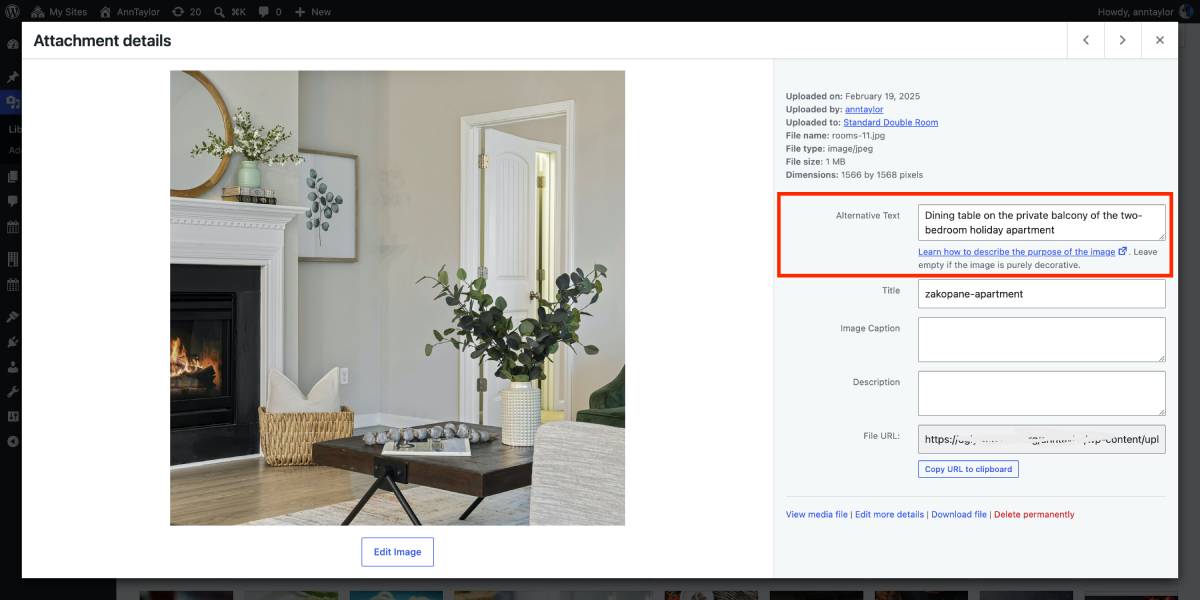
Note: Unique content might be a reason by get cited in LLMs. Add one original element if it helps: a comparison table, route check, original photo with an informative caption, short video, map, or practical checklist. If you include an image, give it accurate alt text – for example, alt="Dining table on the private balcony of the two-bedroom holiday apartment" – and provide essential information as text as well.
7. Use AI to help with content, not replace your knowledge
AI can help you brainstorm questions, organize notes, create an outline, or edit a draft. It cannot reliably verify every detail about your property or destination by generating a plausible answer.
Use this workflow:
- Provide your verified property facts, intended audience, and the question the page should answer.
- Ask for an outline and a list of missing information.
- Fill gaps using your records and reliable sources.
- Ask AI to improve clarity, headings, and repetition.
- Fact-check all details, including distances, facilities, schedules, and policies.
- Add your own experience, examples, comparisons, and practical advice.
- Read the finished page as a guest before publishing.
Don’t publish dozens of near-identical pages by changing only the property name or keyword. Each page should serve a distinct purpose and provide useful information. Never invent credentials, certifications, customer quotes, test results, or firsthand experiences.
Google does not prohibit AI-generated content as such; its guidance warns against using automation to publish large amounts of content without sufficient originality, accuracy, or user value. See Google’s guidance on generative AI content.
8. Organize related pages into topic groups
Connect relevant accommodation pages, destination guides, and event pages so visitors can move naturally between related information. You don’t need to redesign the entire website; start with pages you already have.
Step 8.1. Build a small topic cluster
For example, a property owner in Mallorca could organize useful content like this:
Main destination guide: Planning a Stay in Alcúdia
- Getting Around Alcúdia Without a Car
- Beaches Near Alcúdia for Families
- Local Markets and Activities in Alcúdia
- Where to Stay Near Alcúdia Beach
The main guide should briefly introduce the main topics and link to the detailed pages. Each supporting page should answer a distinct question in depth.
Step 8.2. Connect the pages
- Add a short overview of the main destination topics to the guide.
- Link each overview to the relevant detailed page.
- Link supporting pages back to the main guide where it helps readers.
- Link from accommodation pages to destination guides that answer likely guest questions.
- Use descriptive anchor text that explains what visitors will find.
- Check that important pages are reachable through normal navigation or other crawlable internal links.
Don’t create a page for every keyword variation. Publish a supporting page only when it has a distinct purpose and enough useful information to serve that purpose.
9. Detailed example: Improve a holiday apartment page for AI search
Let’s walk through the process using a fictional two-bedroom holiday apartment near Alcúdia, Mallorca. The details below are illustrative. Replace them with verified facts about your own property.
The goal is to improve one accommodation page so it answers practical traveler questions, explains the property clearly, and connects to useful destination information.
Step 9.1. Define what the page needs to communicate
Imagine your current page starts with this description:
Welcome to our beautiful Mediterranean apartment! Enjoy an unforgettable holiday in a stunning location close to everything you need. Our lovely accommodation is perfect for families and couples looking for a relaxing getaway.
The text sounds familiar because many accommodation websites use similar phrases. It tells a traveler very little about the actual apartment, its location, or whether it suits their needs.
Before rewriting it, define the page’s purpose.
| Item | Working brief |
|---|---|
| Main audience | Couples and small families planning a beach holiday |
| Main traveler needs | Understand accommodation, beach access, parking, nearby amenities, and whether a car is necessary |
| Verified differentiators | Two bedrooms, private balcony, outdoor dining table |
| Important limitations | No private parking; paid public parking nearby |
| Destination context | Beach access, restaurants, shops, and local transport |
| Main action | Check availability and book directly |
This brief helps you decide what information belongs on the page. You don’t need to target every possible traveler or describe every local attraction.
Step 9.2. Verify the details before writing
Gather the facts from property records, direct observations, maps, and reliable external sources.
| Detail | What to verify | Where to check |
|---|---|---|
| Accommodation | Bedrooms, guest capacity, beds, bathrooms | Property records and direct inspection |
| Outdoor space | Whether the balcony is private, furniture, shade | Direct inspection and photos |
| Beach access | Named beach, actual walking route, approximate distance | Map and route verification |
| Parking | Private or public, paid or free, location and restrictions | Property records and parking operator |
| Nearby services | Shops, restaurants, transport stops | Current maps and official sources where available |
| Family facilities | Cot, high chair, stairs, relevant safety limitations | Property inventory and direct inspection |
| Internet | Availability, measured speed, rooms covered | Connection test at the property |
| Policies | Check-in, fees, cancellation, pets, seasonal restrictions | Current booking policies |
Do not turn assumptions into selling points. If you haven’t tested the Wi-Fi speed, don’t claim it is ideal for video calls. If you have only checked the straight-line distance to a beach, don’t describe that as the walking distance.
Keep a record of the source and date for information that can change, such as transport schedules, beach facilities, and seasonal services.
Step 9.3. Rewrite the opening with useful information
Your introduction should identify the accommodation and establish the facts travelers need to evaluate it. It doesn’t have to answer every question or summarize the entire page.
Example copy
Example page H1: Two-Bedroom Holiday Apartment Near Alcúdia Beach
This two-bedroom holiday apartment accommodates up to four guests and has a private balcony with an outdoor dining table. The nearest public beach is approximately [verified walking distance] away along [verified route]. The apartment does not have private parking, but paid public parking is available at [verified location].
The apartment may suit couples or small families looking for a self-catering stay near the beach. Before booking, check the accommodation details below for sleeping arrangements, access information, and facilities.
Why this is stronger
- The reader immediately knows the accommodation type, capacity, and key features.
- The location claim includes a measurable detail rather than “close to the beach.”
- A potential limitation – no private parking – is clear before the reader reaches the bottom of the page.
- The suitability statement is grounded in actual features rather than an unsupported promise that the apartment is “perfect for everyone.”
- The text can be understood on its own without relying on the earlier generic introduction.
Use this as an example of how to communicate verified information, not as a fixed formula every property page must follow.
Step 9.4. Build the page around meaningful sections
The following is a worked example of the content, including details you should verify and nuances you should preserve. Replace every bracketed placeholder before publishing.
H2: What Does the Apartment Offer?
The apartment accommodates up to four guests across two bedrooms. It includes [verified bed arrangements], [number] bathroom(s), a kitchen with [verified facilities], and a private balcony with an outdoor dining table.
Guests can prepare meals in the apartment and use the balcony for outdoor dining. The property does not provide [any relevant missing facility, if important to guests]. Check the accommodation details and booking conditions for the complete list of included facilities.
What to notice: This section explains the layout and practical use of the space. It doesn’t rely on a long list of adjectives such as “amazing,” “luxurious,” or “beautiful.” Add details about beds, bathrooms, kitchen appliances, air conditioning, heating, laundry, and other amenities only after verifying them.
H2: How Far Is the Beach, and How Do You Get There?
The nearest public beach is approximately [verified walking distance] from the apartment. The usual pedestrian route follows [brief route description], and the walk takes around [verified walking time] at a normal pace.
For guests planning beach visits with small children, luggage, or mobility limitations, check the route itself rather than relying only on the distance. The nearest route may include steps, uneven surfaces, busy crossings, or other conditions worth explaining.
For current beach facilities or access restrictions, consult [relevant official source] before your visit.
What to notice: The section gives a direct answer, describes the route, and adds a practical nuance a generic listing might leave out. It also separates your verified knowledge from information that needs checking elsewhere.
H2: Can You Stay Here Without Renting a Car?
Guests can walk to [verified nearby shops, restaurants, or other destinations]. For places farther away, available transport options include [verified bus route, taxi, or other transport option].
Whether a car is necessary depends on your plans. If you expect to explore several parts of the island, compare the relevant routes and schedules before booking. Public transport frequency and availability can vary by season, so check the current timetable at [official transport website].
| What you need | Information to include |
|---|---|
| Groceries | Nearest supermarket, walking route, opening-hours source |
| Restaurants | Actual nearby options and approximate distances |
| Public transport | Nearest stop, routes, timetable link |
| Airport transfer | Available options, approximate journey time, current booking information |
| Car parking | Location, charges, restrictions, walking route back to the apartment |
What to notice: The table makes practical details easy to compare and helps you spot gaps. If you cannot answer how guests reach the supermarket or whether transport runs late in the evening, research it before publishing.
Don’t claim the apartment is “ideal for a car-free holiday” unless the available transport and walkable amenities genuinely support that claim.
H2: Is the Apartment Suitable for a Family with Children?
The apartment accommodates up to [verified capacity] guests and includes [verified family facilities, such as a cot or high chair, if available]. Its layout includes [relevant verified details].
Please note that [relevant limitations, such as stairs, an unsecured balcony, or the absence of child-specific equipment]. Contact the property before booking if you require particular facilities.
What to notice: “Family-friendly” is not a substitute for information. Parents need to know what is available, how the accommodation is arranged, and what limitations might affect their stay. Be careful not to make unverified safety claims.
H2: Where Can You Eat and Shop Near the Apartment?
The apartment is located near [verified neighborhood or area]. Guests can find [verified types of shops, restaurants, or services] in [specific area], approximately [verified distance or walking time] away.
For guests who prefer self-catering, the nearest suitable supermarket is [name or location], with details available at [relevant source, if useful]. If you recommend a restaurant or shop, explain why it may suit a particular visitor instead of simply listing as many businesses as possible.
For example, you might highlight a nearby market that operates on a particular day or explain which shops remain open outside peak season – but only after checking current information.
What to notice: Naming relevant places and explaining their practical value creates richer destination context than repeating the town’s name throughout the page. Don’t make promises about current opening hours without checking them.
Step 9.5. Add original information that makes the page more useful
Compare the draft with similar listings. Ask what your page can tell travelers that isn’t already covered by a generic description.
For this apartment, that could be:
- A verified walking route to the beach, including practical access details.
- An honest explanation of parking options and where guests should leave their car.
- A route to the nearest supermarket with a note about steep sections or crossings, if relevant.
- A description of how the balcony is furnished and whether it offers shade at particular times, if you have checked this.
- An original annotated map or photographs showing access points and important facilities.
Add the detail that is most useful to your audience. You don’t need to invent an unusual feature just to make the page different.
If you include original photos, use accurate alt text and useful captions. For example: alt="Dining table on the private balcony of the two-bedroom holiday apartment". This describes the image more clearly than “beautiful apartment photo.” If you add a route map, make sure the route is accurate and provide a written description too. Don’t make essential information available only inside an image.
Step 9.6. Connect the page to your destination content
The apartment page should provide the essential facts about the accommodation. More detailed destination information can live on relevant supporting pages.
Imagine you have these related pages:
- Planning a Stay in Alcúdia – the main destination guide.
- Getting Around Alcúdia Without a Car – transport options and practical routes.
- Beaches Near Alcúdia – beach access and useful visitor information.
- Where to Eat Near Alcúdia – selected restaurants and local dining advice.
From the apartment page, link to the pages that answer the next logical question for a potential guest.
Example internal link (text in Italics) copy:
Planning to explore the area without a car? Read our guide to getting around Alcúdia without a car, including local transport options and practical route information.
On the destination guide, link back to the apartment page where it genuinely fits the reader’s needs. Use descriptive anchor text that tells visitors what they will find; avoid a series of generic “click here” links.
Each supporting page should have its own purpose. The transport guide should provide practical transport information, not repeat the apartment description with a few words changed. The beach guide should cover relevant beaches and visitor considerations, not exist solely to link to the accommodation.
Step 9.7. Add evidence and keep information current
Review every statement that could affect a guest’s decision. For this apartment, verify:
- Capacity and sleeping arrangements.
- Walking distances and route descriptions.
- Parking arrangements and applicable charges.
- Internet claims, if made.
- Family facilities and accessibility details.
- Local transport information and seasonal recommendations.
Link to official or otherwise reliable external sources where they help readers verify changeable information. For example, link to the official transport operator for schedules rather than copying a timetable without a review process.
Add a visible update date when it is useful to readers, especially on destination guides containing seasonal or time-sensitive advice. An update date alone doesn’t establish reliability; the information must actually have been reviewed.
Step 9.8. Review the completed page
Use this checklist before publishing.
- ✓ The page identifies the accommodation and its main features in the opening section.
- ✓ Important details are specific and verified.
- ✓ Headings describe the content that follows and reflect genuine traveler concerns where appropriate.
- ✓ Each section can be understood without relying heavily on distant parts of the page.
- ✓ The text is concise but includes enough practical detail to support a decision.
- ✓ Claims such as “family-friendly,” “quiet,” or “car-free” are supported by facts and limitations.
- ✓ The page includes useful original details rather than generic copy that could describe any apartment.
- ✓ Images have accurate alt text, and essential information is available as text.
- ✓ Related destination and accommodation pages are connected through useful internal links.
- ✓ External facts and seasonal information have reliable sources and a review routine.
- ✓ No fabricated testimonials, certifications, test results, or claims of firsthand experience have been added.
- ✓ The page has been checked on mobile, and important information is visible without requiring complex interactions.
10. What to measure afterwards
Track a small set of metrics so you can assess the work over time.
| Metric | How to check it |
|---|---|
| Content completeness | Review the page against your verified property facts and original content brief. |
| Indexing and technical health | Use Google Search Console to check indexing and identify page issues. |
| Search performance | Track relevant queries, impressions, and clicks in Search Console. |
| Generative AI visibility | Use Google’s Generative AI performance report if available for your site. |
| AI description accuracy | Test realistic traveler prompts and record whether details are correct and which sources are cited, where available. |
| Visitor engagement | Use your analytics to check whether visitors reach booking pages or take other meaningful actions. |
Record a baseline before making changes and repeat checks periodically. AI answers vary by prompt, location, platform, and time, so a single response isn’t reliable evidence of success or failure.
11. Common mistakes to avoid
- Writing for a supposed chunking formula. Use clear sections for readability and context, not a fixed sentence count intended to manipulate retrieval.
- Turning every keyword variation into a heading or page. Cover genuine traveler needs naturally without creating repetitive content.
- Replacing facts with confident marketing claims. Explain what the property actually offers and qualify information where needed.
- Publishing generic AI-generated copy. Add firsthand experience, verified facts, and original practical information.
- Citing outdated information. Check transport schedules, event dates, seasonal facilities, and other changeable details.
- Stuffing pages with promotional links. Use booking links and external references where they help the visitor.
- Building a topic cluster without a purpose. Every supporting page should answer a distinct question.
- Treating a visibility score as a guarantee. No heading format or content tool can guarantee inclusion in AI answers.
12. The next logical step
Choose another important page on your website and repeat the process. Connect your improved accommodation and destination content to your Property Information Master, FAQ Bank, and online presence audit.
The repeatable workflow is simple: choose a real traveler need, verify the facts, write useful content, connect related pages, and review the result. The goal is not to write for an assumed AI algorithm, but to make it easier for modern travelers – and the systems helping them research – to understand what your property offers.