
Table of Contents
What you’ll learn:
You’ll learn how on-page, technical, local, and off-page SEO work together to help guests discover your accommodation. You’ll understand where mobile usability, AI search, and voice search fit, which tactics deserve your attention, and how to assess progress beyond rankings and website traffic.
Key takeaway:
Effective accommodation SEO helps suitable guests find your property, understand whether it meets their needs, and move toward booking. That requires accessible pages, useful property information, a credible online presence, and a website that works comfortably on mobile. No single keyword, technical score, or piece of structured data can replace that foundation.
What SEO means for an accommodation business today
Search Engine Optimization (SEO) is the work that helps search engines discover, understand, and extract your website’s data to show it in unpaid search results and AI-generated overviews.
For a hotel or vacation rental, this means appearing when someone searches for your property name, accommodation in your area, or a highly specific requirement.
Consider two travelers:
- One finds your hotel on Booking.com, then searches its name on Google to visit the official website.
- Another searches for a “two-bedroom holiday cottage near [City]” and discovers your property for the first time.
The first is a branded search: the traveler already knows your name and is verifying your direct rates. The second is a non-branded search: the traveler knows what they need but hasn’t chosen a property.
Both support direct bookings, but they play different roles. Ranking for your name captures existing interest; appearing for relevant non-branded searches intercepts new guests before they default to an Online Travel Agency (OTA).
Your direct website can be highly lucrative when discoverable. According to SiteMinder’s 2026 Hotel Booking Trends report (analyzing over 130 million bookings), hotel websites generated the highest average booking value across all channels, hitting US$516 per booking.
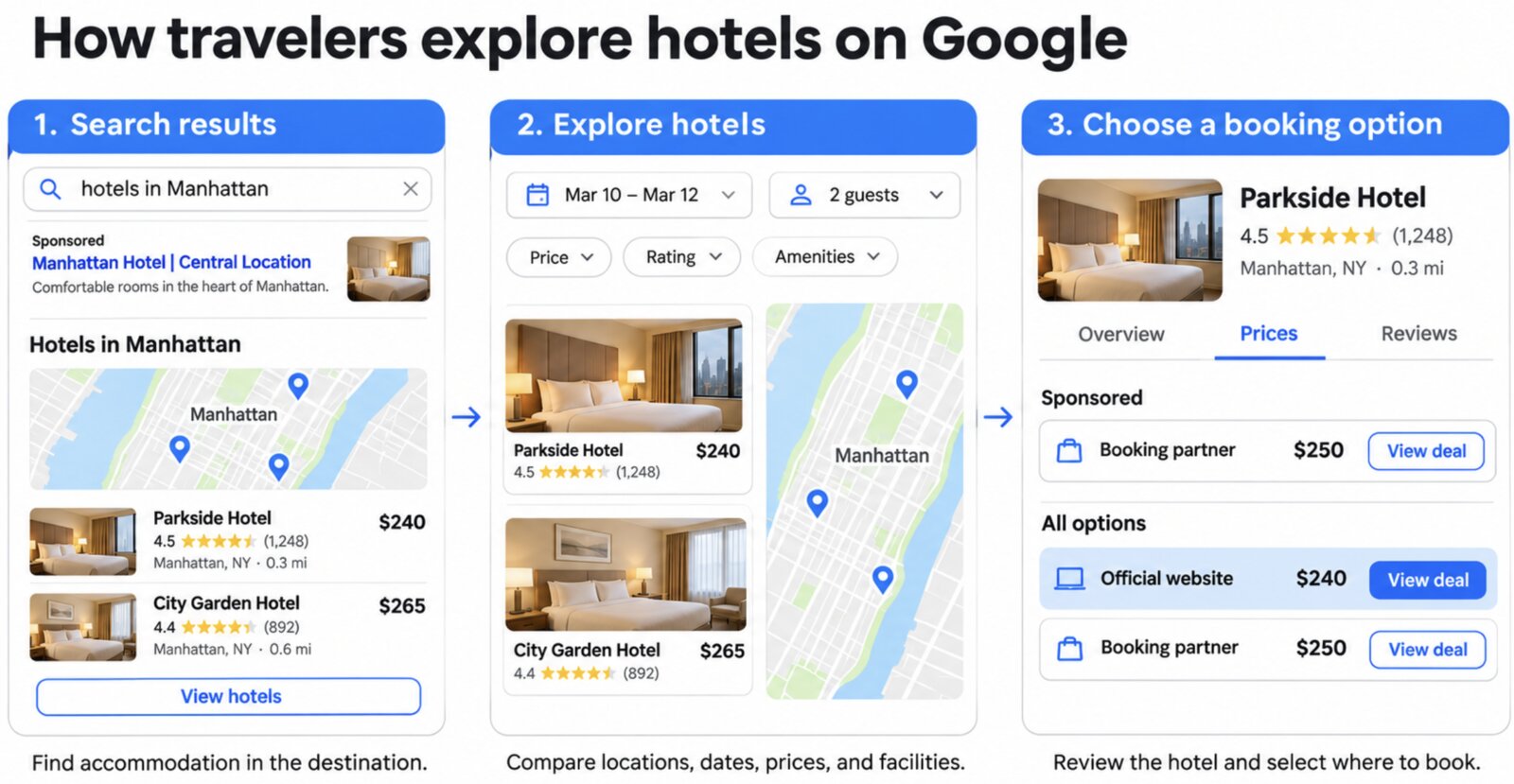
The four main areas of accommodation SEO
SEO is divided into four overlapping areas. Understanding them makes it easier to assess what your website actually needs.
| Area | What it means | An accommodation example |
|---|---|---|
| On-page SEO | Improving the content, structure, and intent of individual pages. | A cottage page clearly explains its location, bedroom layout, amenities, and exact pet policy. |
| Technical SEO | Helping search engines access and process your code, while ensuring a fast mobile experience. | Room details can be crawled natively without forcing Google to enter dates into a booking widget. |
| Off-page SEO | Building relevant links and a credible presence beyond your own website. | A local wedding venue or tourism board links to your property in their accommodation directory. |
| Local SEO | Helping people discover your business in connection with a physical place. | An eligible hotel maintains a perfectly accurate, highly-reviewed Google Business Profile. |
1. On-page SEO: Make each page useful for a particular search
On-page SEO connects the topic of a page with what a traveler wants to know. For accommodation websites, the main elements include:
| Element | Its purpose |
|---|---|
| Page title | Identify the page’s subject; Google may use it for the search result title |
| Headings | Organize information so visitors can scan the page |
| Main content | Answer the questions relevant to this accommodation or topic |
| Internal links | Connect related pages within your website |
| Images and alternative text | Show the property and describe meaningful visual information accessibly |
| Meta description | Summarize the page for a possible search snippet |
Related Guides:
- Build a keyword map for your website
- Optimize your homepage for your main location and property type
- Optimize your accommodation/property pages for search
2. Technical SEO: Make your important data accessible
Technical SEO addresses whether search engines can find, access, and process your website’s content.
Two terms help here:
- Crawling: a search engine visits a page to retrieve its content.
- Indexing: it processes that content and may include the page in its searchable index.
A page being online does not automatically mean it is indexed. Being indexed does not guarantee a high ranking.
Google guidance identifies working, accessible pages with indexable content as basic requirements for search visibility.
Structured data is another part of this foundation. It provides machine-readable labels for information on a page. Appropriate markup can help Google understand content and determine eligibility for supported search features, but it does not guarantee enhanced results.
Related Guide:
- Fix the most important basic SEO issues on your website
3. Local SEO
Local SEO connects your business with its actual location and the places relevant to a stay.
For eligible hotels and accommodation businesses, Google Business Profile is part of that presence (note: Google lists individual vacation rentals as ineligible for Business Profiles).
Google describes its local ranking factors as relevance, distance, and prominence.
Related Guide:
- Build website pages around events happening in your area.
4. Off-page SEO
Off-page SEO concerns signals and relationships outside your own pages, especially links from other websites.
A backlink is simply a link from another website to yours. For an accommodation business, relevant examples include:
- A tourism organization listing your property.
- A wedding venue recommending nearby places to stay.
- A local publication featuring your accommodation.
- A conference organizer including your hotel in its visitor information.
These connections can help people discover your property and send visitors with a genuine reason to stay nearby.
However, buying links to manipulate rankings can violate Google’s spam policies. Equally, a mention does not automatically certify your property as a “verified entity” to an AI system.
The strongest practical starting point is your real involvement in the destination: partnerships, memberships, events, and stories that give another organization a reason to refer people to you.
Mobile optimization: guests need to evaluate and book on a phone
Mobile optimization affects both search accessibility and the experience after a guest arrives.
Google uses the mobile version of a website’s content for indexing and ranking. Important information should therefore remain available on mobile, even if its layout differs from desktop.
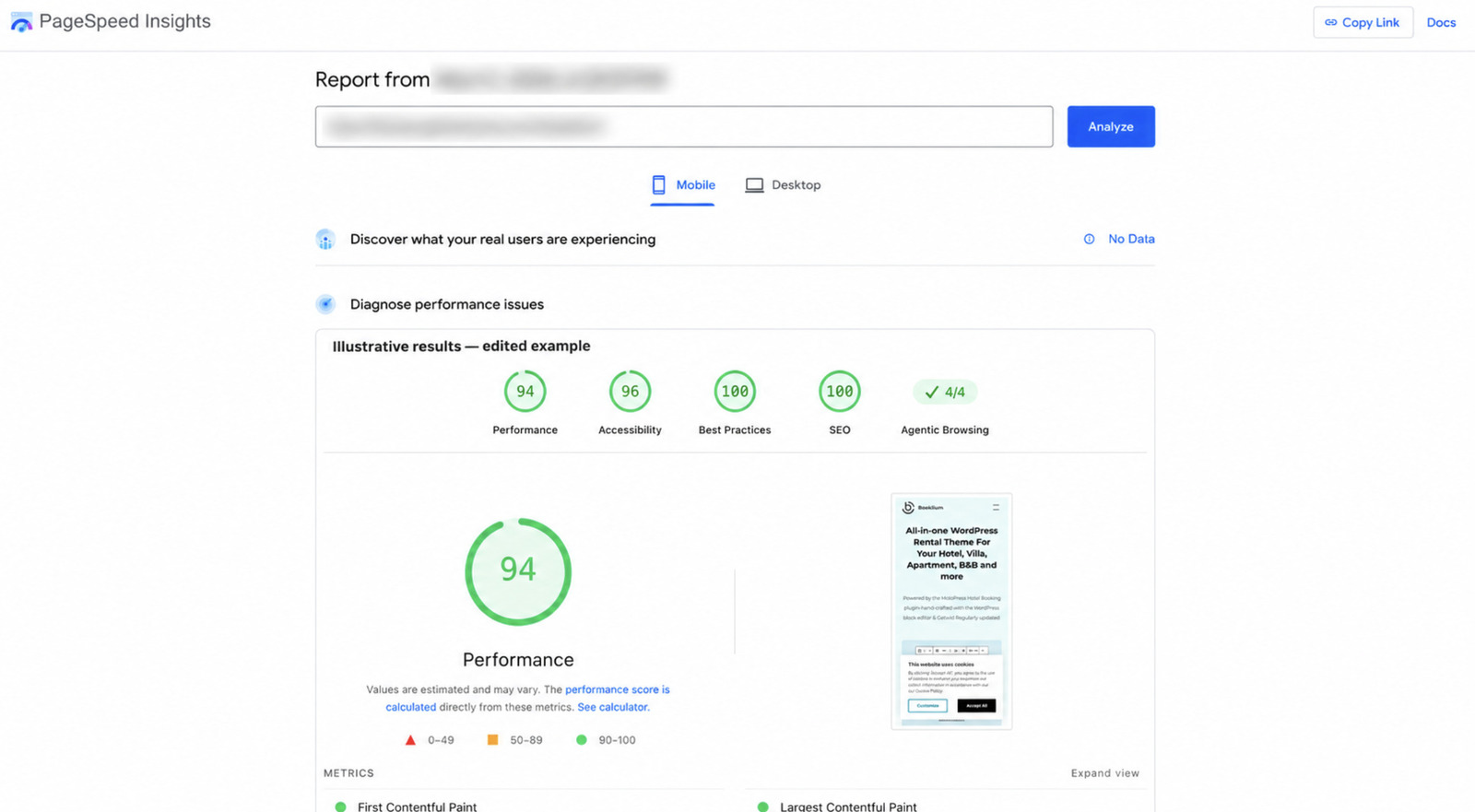
Core Web Vitals measure three aspects of page experience:
| Measure | What it checks | What a guest might notice |
|---|---|---|
| Loading performance | How quickly the main content becomes visible | Waiting for the property page’s main image and information |
| Responsiveness | How quickly the page responds to interaction | A delay after tapping a menu or button |
| Visual stability | Whether content unexpectedly shifts | A button moving just as the guest tries to tap it |
These metrics contribute to Google’s assessment of page experience. However, good scores do not guarantee top rankings, and speed alone cannot compensate for irrelevant content. The practical concern is whether someone can comfortably understand the accommodation and complete their task.
How SEO connects with AI search and GEO
You may also come across the term GEO (Generative Engine Optimization). It describes efforts to make your content easier for AI-powered search and answer tools to discover, understand, and use in their responses.
For a hotel or vacation rental, this could mean being mentioned when someone asks for accommodation that matches a particular location, budget, or set of requirements.
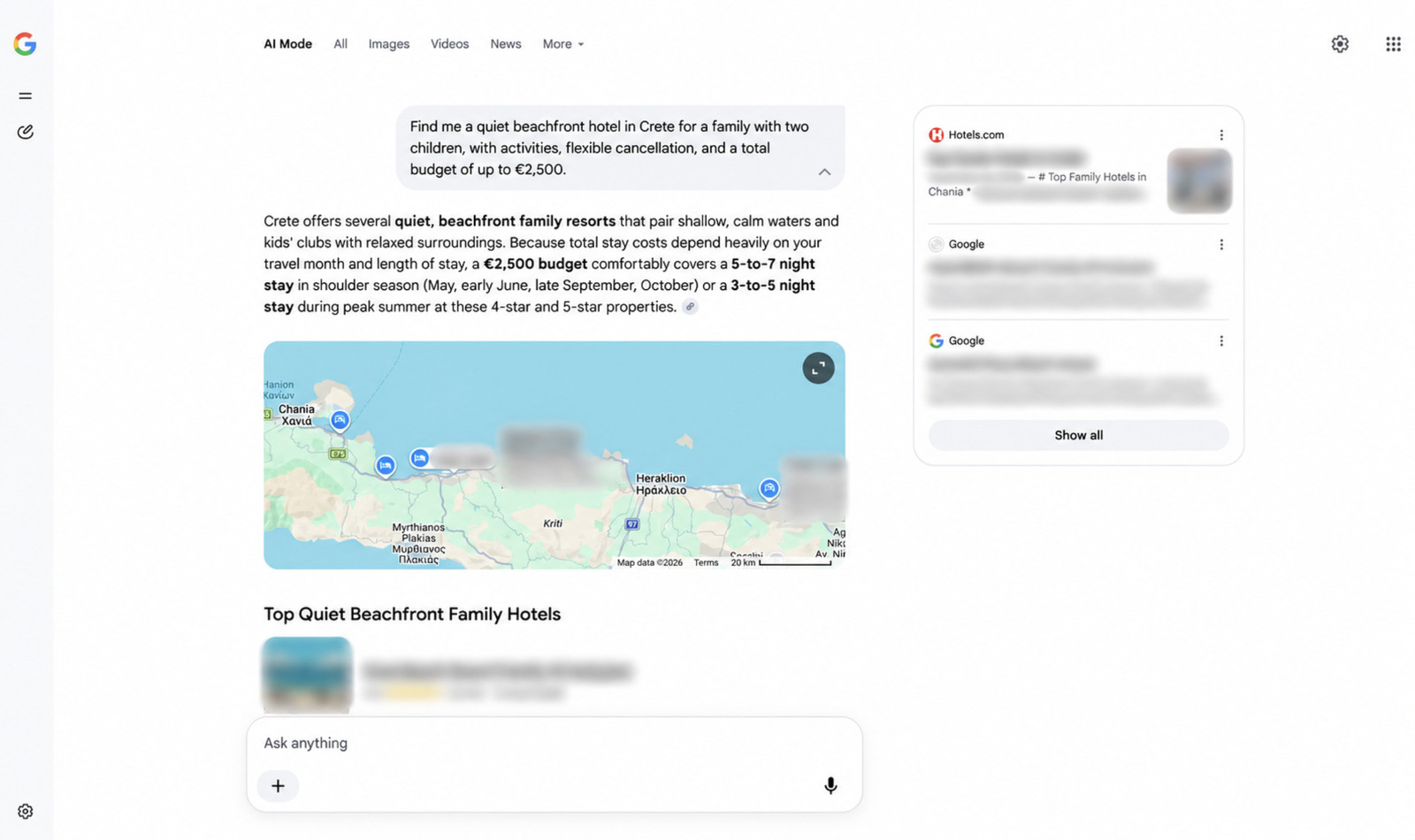
GEO overlaps with SEO: accessible pages, accurate property details, useful answers, and relevant external references can support both. However, appearing in traditional search results does not guarantee an AI recommendation, and adding structured data does not guarantee one either.
Visibility does not always produce a website visit anymore. According to July 2025 research published by the Pew Research Center, users clicked a traditional search result on just 8% of visits to Google pages that featured an AI summary (compared to 15% without one).
Related Guides:
- Make important property information easy for search engines and AI systems to understand
- Check how AI platforms describe your property
Voice search: answer the questions guests can ask aloud
Voice search means speaking a request instead of typing it. A traveler might ask: “Where can I stay near the station with parking?”
Speaking can encourage natural questions, but typed searches and AI conversations can use the same wording. For an owner, the useful content principle is the same: provide a clear, accurate answer.
You can answer such questions in the relevant page section or a concise FAQ. There is no reason to turn every sentence into a question or create a separate page for each wording variation.
The value is in removing uncertainty. Question-based wording alone does not guarantee that a voice assistant will select your website or recommend your property.
Related Guides:
- Find the search terms your potential guests actually use
- Customize website pages based on traveler intent and audience segment
Measuring True SEO Progress
How do you know whether your SEO work is making a difference? Higher rankings and more visitors can be encouraging, but they only tell part of the story. For your property, progress also means attracting people who explore your accommodation, check availability, and make enquiries or reservations.
| Tool | What it helps you understand |
|---|---|
| Google Search Console | How your website appears in Google Search, which queries and pages receive impressions and clicks, and whether pages have indexing issues |
| Google Analytics 4 (GA4) | What tracked visitors do after arriving, including the booking or enquiry actions you have configured. |
Related Guides:
- Set up Google Search Console
- Audit your website’s current Google visibility
Concluding: The main things to know
– SEO serves both guests who know your name and those still choosing accommodation.
Branded searches help travelers find your official website after discovering your property elsewhere. Relevant non-branded searches can introduce you to people looking for a particular location, property type, or facility. Both matter: one supports existing interest, while the other creates opportunities for discovery.
– The four areas of SEO work together.
On-page SEO makes individual pages relevant and useful. Technical SEO helps search engines access and understand them. Local SEO connects your accommodation with its location, while off-page SEO builds connections beyond your website. Understanding these roles helps you identify what is missing instead of treating every visibility problem as a need for more keywords.
– Specific property information helps guests judge suitability.
Bedroom layouts, parking arrangements, pet policies, and transport connections give travelers concrete reasons to consider your accommodation. These details belong on pages where they answer the reader’s questions. Useful content starts with what a guest needs to understand before choosing a stay.
– Mobile usability connects search visibility with the booking experience.
Important content needs to be accessible on mobile, and guests should be able to explore photos, read policies, select dates, and use the booking form comfortably. Performance metrics can reveal obstacles, but a good score is only part of the picture. The experience needs to work for the person using it.
– AI and voice search reinforce the value of clear answers.
Travelers can express their requirements through typed searches, spoken questions, or AI conversations. Accurate descriptions and accessible content help communicate whether your property fits those requirements. Structured data can support understanding and eligibility for certain features, but it does not guarantee rankings or recommendations.
– Meaningful SEO progress includes what happens after discovery.
Search Console helps you understand visibility, queries, clicks, and indexing. GA4 helps you examine tracked activity after visitors arrive. Together, they can help connect search performance with accommodation exploration, enquiries, and reservations. The goal is to understand whether your website is attracting relevant interest and helping guests take the next step.
Help guests go from finding your website to booking their stay
SEO brings potential guests to your accommodation website. Once they arrive, they need a straightforward way to check availability, choose their accommodation, and make a reservation.
MotoPress Hotel Booking adds that booking experience to your WordPress website. Manage availability and rates, accept online reservations and payments, and sync availability calendars with OTAs – all while giving guests a direct way to book with you.