
Table of Contents
What you’ll learn:
You’ll learn how Google discovers, indexes, and selects accommodation pages for different searches. You’ll understand how relevance, credibility, usability, and context influence results, why website rankings differ from local listings and booking links, and how AI answers fit into this process.
Key takeaway:
Google selects results for a particular search, rather than giving your property one universal ranking. Your homepage, room pages, local listing, and booking links can appear differently because they serve different purposes. Understanding which page or listing appears and what the traveler is trying to accomplish makes your visibility easier to assess.
You search for your property’s name and see your website near the top. Then you search for “family hotels in [Your Location]” and find booking platforms and competitors instead.
That difference does not necessarily mean something is wrong. The two searches ask different questions: one seeks a known business; the other asks Google to help compare accommodation.
To understand visibility, it helps to follow the process from the beginning.
1. Google needs to find and understand the page
Google describes three stages of Search:
| Stage | What it means | Example for your website |
|---|---|---|
| Crawling | Google visits a page and retrieves its content. | It follows a link from your accommodation listing to a new cottage page. |
| Indexing | Google analyzes the page and may store information about it in its search index. | It processes the cottage’s description, location, images, and other content. |
| Serving results | Google selects relevant information when someone searches. | The cottage page becomes a possible result for a related accommodation search. |
Publishing a page does not guarantee that it passes through every stage.
For example, information available only after a guest signs in may be inaccessible to Google. A page can also contain instructions preventing indexing. Even an indexed page may not be selected prominently for the searches an owner has in mind.
Being indexed means a page can be considered. It does not mean that Google considers it the best answer.
Related Guide:
- Set up Google Search Console
2. Google interprets what the traveler wants
Google’s ranking explanations identify meaning, relevance, quality, usability, and context as important considerations. Their importance varies with the query. Google does not publish a fixed accommodation-ranking formula.
The starting point is understanding the request.
| Illustrative search | What the traveler likely needs | A potentially useful page |
|---|---|---|
| “Best area to stay in Bath without a car” | Help choosing a location | A neighborhood and transport guide |
| “Family hotels in Bath” | Options to compare | A hotel collection, booking platform, or relevant property page |
| “Willow House Bath family room” | Details about a particular room | The hotel’s family-room page |
| “Willow House Bath parking” | An answer to a practical question | Parking or arrival information |
These examples explain the relationship between a search and an answer. They are not predictions of exact rankings.
This also helps explain why an OTA can appear above an individual hotel for a broad search. A comparison page may serve someone who has not yet chosen a property. For a detailed question about a particular hotel, the official website may offer more specific information.
Google is evaluating the usefulness of the result for the task, not simply identifying who owns the property.
It uses language-understanding systems to connect words with concepts. Relevant pages can match a query without containing every exact word the traveler typed. Keywords help communicate the subject, but repetition cannot replace an answer.
Related Guide:
- Build a keyword map for your website
3. Google compares the relevant pages
Several pages may answer a search. Google then uses multiple signals to decide which results seem most useful.
For accommodation owners, three ideas are particularly helpful: the relevance of the individual page, the quality and credibility of its information, and the experience of using it.
Google says its ranking systems work at the page level while also considering site-wide signals. A strong website does not guarantee that every page ranks highly.
Your homepage may introduce the business well, while a room page answers a more specific question. A visitor searching for parking information may reach your location page first.
This is why “my website ranks” is an incomplete description. A more useful question is: which page appears, for which search?
Helpful and credible information matters
Google’s content guidance emphasizes original, reliable information that serves the reader’s purpose.
It also discusses E-E-A-T: experience, expertise, authoritativeness, and trustworthiness. This framework describes qualities its systems aim to recognize. E-E-A-T is not a single ranking factor or a score that a property receives. Human quality raters help evaluate Google’s systems; they do not directly set your page’s position.
An owner’s firsthand knowledge can therefore be valuable, provided it becomes useful information for the guest.
Links also play a role. Google uses link-analysis systems to understand relationships between pages and assess which may be helpful. A genuine link from a local tourism organization can connect a property with relevant destination information. However, no fixed number of links guarantees a position.
Usability supports the answer
Google confirms that Core Web Vitals are used in ranking. They measure loading performance, responsiveness, and visual stability. Good results do not guarantee top positions, and Google advises against chasing a perfect score solely for SEO.
A fast-loading page still needs relevant content. Equally, useful information becomes frustrating when it is difficult to read or interact with on a phone.
Ranking and booking performance are also different. A confusing booking form can lose reservations after a visitor arrives, even if the page attracts search traffic.
Related Lesson:
- SEO for hotels and vacation rentals: what actually matters
Help guests move from finding your property to booking their stay
Once a traveler reaches your website, they need a clear way to check dates, compare accommodation, and make a reservation.
MotoPress Hotel Booking brings availability search, accommodation listings, and online reservations to your WordPress website. Guests can explore suitable options and book directly, while you manage rates, availability, and reservations in one place.
4. Context helps explain why results differ
There is no permanent results page that every traveler sees. Google considers context such as location, language, and settings when selecting results. The available competitors and Google’s systems also change over time.
Google’s traffic guidance distinguishes changes in demand, technical issues, and changes in ranking systems. These require different interpretations.
Freshness is also query-dependent. A guide to this year’s festival may need current dates and transport information. An accurate room description does not become unhelpful simply because it was written earlier. Google has freshness systems for searches where recent information matters.
Related Guide:
- Audit your website’s current traffic [GA4]
5. Google’s accommodation features add different selection criteria
So far, we have discussed website pages. But a traveler can also encounter a map, property listings, prices, and booking links.
These are related forms of visibility, with different purposes. A property’s position in one does not determine its position in all the others.
Local results
Google identifies three main factors for local ranking:
| Factor | What it means |
|---|---|
| Relevance | How closely the business matches the search |
| Distance | How far the business is from the location relevant to the search |
| Prominence | How well-known the business is, including signals such as links and reviews |
Google states that more reviews and positive ratings can help local ranking. It does not publish percentage weights for these factors. Industry estimates should not be treated as the actual algorithm.
Hotel booking links
Once a traveler is considering a hotel, Google may show ways to book it. The order of those booking options is a different question from which hotel or webpage appears first.
Google explicitly states that Free Booking Links are ranked based on their “utility to users,” and ad bids have zero impact on this organic placement. To ensure your “Official Website” link outranks the Online Travel Agencies (OTAs) in this free section, Google evaluates:
- Rate Accuracy and Freshness: Google severely penalizes properties that send stale pricing.
- Rate Competitiveness (Parity): Your direct rate must match or beat what the OTAs are showing. If your official website is priced higher than Booking.com right next to it, Google knows users won’t click it, and your visibility advantage is wasted.
- Landing Page Quality: The page guests land on must load fast on mobile (passing Core Web Vitals like a Largest Contentful Paint under 2.5 seconds) and instantly reflect the exact dates the guest selected.
6. Answers in AI Mode and AI Overviews
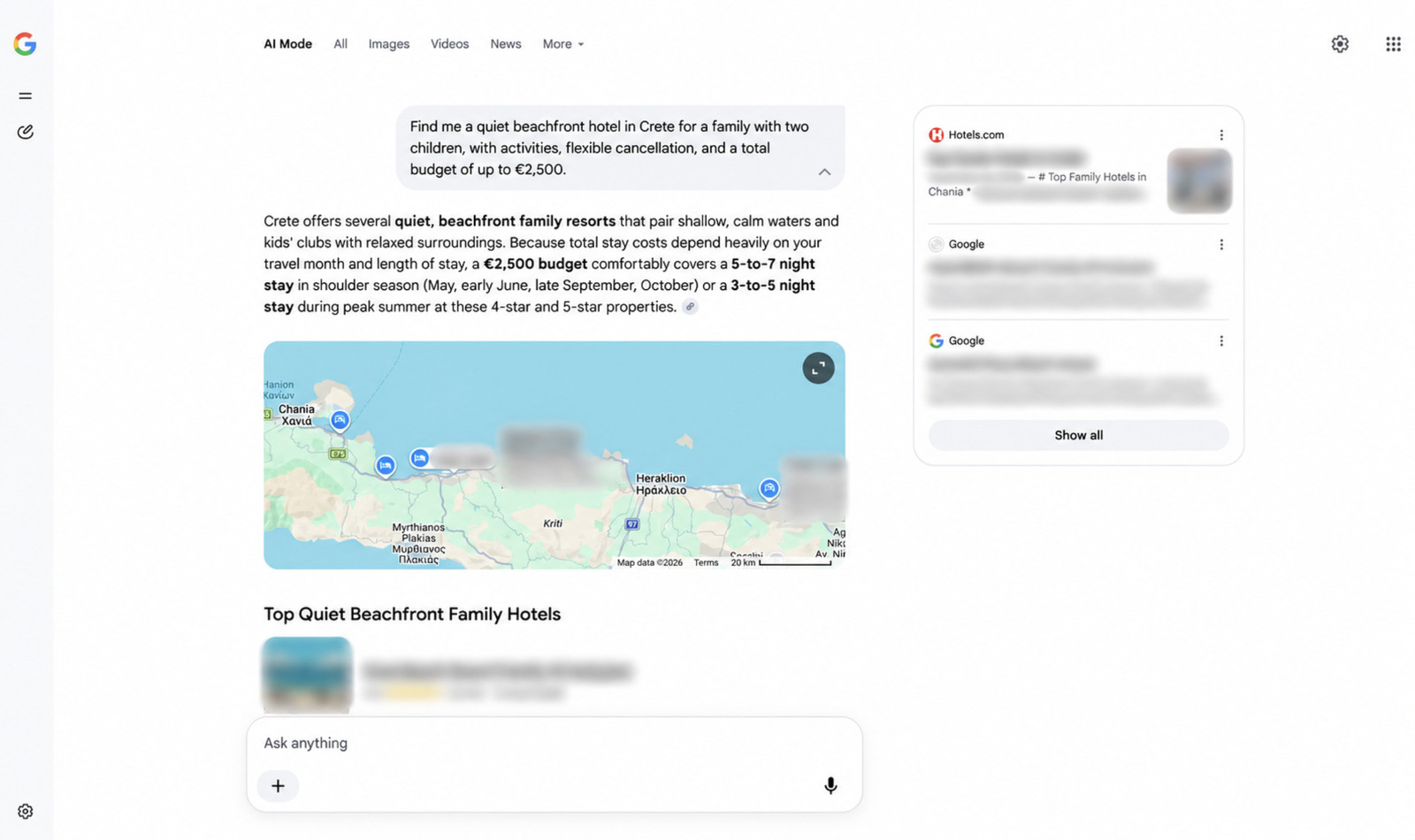
Google’s AI Overviews and AI Mode draw on its Search ranking and quality systems. Its generative AI guidance explains that these experiences can retrieve pages and conduct related searches to explore different parts of a request.
Google calls this query fan-out. To be eligible as a supporting link in AI Overviews or AI Mode, a page must be indexed and eligible to appear in Search with a snippet. Google says there are no additional technical requirements or special optimizations necessary for these features.
Visibility does not always lead to a website visit
Pew Research Center’s study found that users clicked a traditional search result in 8% of visits with an AI summary, compared with 15% without one.
The lesson for accommodation owners is that position, visibility, and clicks are different measures. Changes in the results page can influence traffic even when a website remains relevant.
Related Guides:
- Audit how your property is represented across the web
- Fix the most important basic SEO issues on your website
Concluding: The main things to know
– Being accessible and indexed is the starting point for visibility.
Google needs to discover and process a page before it can consider showing it in search results. Publishing useful information does not automatically mean it will be indexed or rank prominently. This distinction helps separate a technical access problem from a page that is available but competing with more relevant results.
– The traveler’s question determines what makes a useful result.
A broad accommodation search may call for several options to compare, while a search for a specific hotel’s parking arrangements needs a direct answer. This explains why a booking platform might appear prominently for one query and an individual property page for another. Your official website’s advantage comes from the useful, specific information it can provide.
– Individual pages contribute to your search presence.
Your homepage does not need to answer every possible guest question. Room pages, location information, and local guides can each serve a different purpose. Thinking in terms of pages and searches gives you a clearer understanding of visibility than simply asking whether your website “ranks well.”
– Relevance, credibility, and usability work together.
Accurate descriptions and firsthand knowledge help answer the search. Relevant external references can support credibility, while a usable page makes the information easy to access. No single keyword, link, or performance score guarantees a position. These elements contribute to the overall usefulness of the result.
– Website results, local listings, and booking links have different selection criteria.
A strong organic position does not automatically produce a strong position in Maps or among hotel booking options. Local results consider relevance, distance, and prominence. Booking links help travelers evaluate ways to reserve a particular property. Understanding these differences helps you identify which part of your visibility needs attention.
– Results can change without your website becoming less useful.
Location, language, search demand, competing pages, and changes to Google’s systems can affect what appears. Freshness also matters differently depending on the question: event information may need frequent updates, while an accurate room description can remain useful. A change in traffic therefore needs context before you decide what it means.
– Visibility, website visits, and reservations are separate outcomes.
A traveler may encounter your property in a result or AI answer without visiting your website immediately. Someone who does click still needs suitable accommodation, clear conditions, and an easy booking process. Assessing these outcomes separately helps you understand whether the challenge lies in discovery, attracting a visit, or turning interest into a reservation.