
Table of Contents
What you’ll learn:
You’ll see how AI (LLMs) is changing the way travelers search for destinations and accommodation, what they ask AI tools during trip planning, and why making your direct booking website visible and accessible through AI tools can help more travelers discover your property.
Key takeaway:
AI search is NOT replacing Google when travelers search for a place to stay. But there is a very rapid growth of these additional search touchpoints. LLMs/AI tools are trained on historical data – the earlier they ‘consume’ the information about your property, the better long-term results for the visibility of your direct booking channel and property overall.
How LLMs help with planning trips
Planning a trip and managing all the logistics has always been a mentally overwhelming and time-consuming process, requiring travelers to gather and fact-check information across multiple platforms.
Now, many travelers rely on tools like ChatGPT for quicker shortcuts and more convenient, time-saving ways to plan their trips.
New search experiences that AI search brought create new search activity. When users discover that they can ask more complex questions, they may begin searching for things they wouldn’t previously have attempted to find.
Accommodation searches are becoming more about situations, not just categories. A traveler may describe a family trip, transport needs, desired atmosphere and location rather than search for a generic hotel or rental. Property content needs to communicate enough detail to establish whether it fits those needs.
How fragmented search and planning look now:
- ChatGPT / Gemini / Google AI Mode: ask a question and get destinations, neighborhoods, activities, and accommodation suggestions.
- Investigate or book.
Phocuswright’s 2026 research found that 56% of U.S. travelers had used AI for planning, booking, or in-destination assistance during the previous 12 months. Among people who had used AI, 94% had used it specifically for travel. Generative AI platforms such as ChatGPT reached 33% usage for trip research, up from 2024.
But Expedia’s 2026 research still found that only 8% of U.S./UK travelers said they rely on AI chatbots or agents such as ChatGPT or Gemini when planning a trip, compared with 59% using search engines and 49% using OTAs.
At the same time, Google Travel Trends is seeing the same shift from another angle: search interest in “AI travel assistant” and “AI concierge” grew 350% year over year in 2026.
Google SEO engineers also explain that AI search accommodates both vague and highly specific requests. It can help interpret an incomplete question or work with multiple constraints, such as a particular type of restaurant, dietary requirements, location and opening hours.
So, travelers increasingly use LLMs/AI tools like ChatGPT to:
- Discover destinations
- Narrow down options
- Build itineraries
- Find restaurants and activities
- Personalize trips
- Overcome information overload
- Ask conversational follow-up questions
- Discover things they wouldn’t necessarily find through traditional search.
There is a lot of research that supports this:
| Research | Key finding | Why it matters to you |
|---|---|---|
| Phocuswright – The AI Surge: Travel’s Fastest Behavioral Shift in a Decade, 2026 | 56% of U.S. travelers used AI for planning, booking, or in-destination help during the previous 12 months. (Phocuswright) | Your potential guests are increasingly using AI before they ever reach a booking website. |
| Phocuswright – AI hits its stride, 2026 | 44% of travelers would book directly inside an AI platform, and 40% would let an AI assistant handle flight or hotel bookings. (Phocuswright) | Making your property easy for AI to understand now can help you stay visible as this behavior develops. |
| Deloitte – 2025 Holiday Travel Intent Results | GenAI is used to research activities and attractions (67% of those using GenAI for trip planning), followed by destinations (56%) and accommodations (54%). (Deloitte) | Guests don’t only ask AI “Where should I stay?” They ask about what to do, where to eat, and what area to visit. A property with useful local information on its website can therefore become relevant to AI conversations. |
| Expedia Group – The AI Trust Gap, 2026 | 53% are comfortable letting AI suggest travel options, but 68% still prefer booking with a trusted travel brand. (Expedia Group) | AI may bring the guest to you, but your website still needs to win the booking. AI creates awareness and consideration; your website provides trust. |
| Journal of Consumer Behaviour – Travel Recommendations of Tomorrow, 2026 | Research in the UK and U.S. found that GenAI recommendations can help travelers deal with information overload. (Wiley Online Library) | Travelers use AI to filter a huge number of choices into a shortlist. It’s your chance to be visible with narrow searches like “walkable to the old town” or “suitable for families with young children.” |
| Discover Artificial Intelligence – AI-based conversational recommendation systems, 2026 | A study of 415 tourists found that personalization, explainability, understandability, and natural conversation increase trust in AI travel recommendations. (DOI) | AI needs clear, structured information to make useful recommendations. The more clearly your website communicates your location, amenities, policies, accommodation types, and ideal use cases, the easier it is for AI systems to match your property with the right traveler. |
But trust drops at the transaction stage. Travelers may happily ask ChatGPT “Where should I stay in Crete for a quiet beach holiday?” and then leave the AI environment to investigate a particular hotel, vacation rental or OTA before actually booking.
Which AI tools are travelers using?
There are many AI tools, but we’ll list those that often appear in research and are have the biggest number of users.
The main ones to pay attention to
| AI tool | Why it matters for travel |
|---|---|
| ChatGPT | The most important general-purpose conversational AI for travel discovery. Travelers use it for destination research, recommendations, itineraries, and accommodation research. |
| Google Gemini / Google AI Mode | Particularly important because Google combines conversational AI with its enormous ecosystem of Search, Maps, Hotels, Flights, and reviews. Travelers can book a hotel inside the AI Mode. |
| Claude | Used for conversational research and trip planning, although its travel usage is much smaller than ChatGPT’s. |
| Perplexity | AI-powered search/research tool that is particularly relevant when travelers want answers backed by web sources. |
A 2026 behavioral study by Propellic followed U.S. travelers planning real trips for a week, recording their use of AI from destination research through hotel research and booking. ChatGPT accounted for 47% of all AI-tool use, more than Gemini and Google AI Mode combined. The participants mostly used ChatGPT, Gemini, Google AI Mode, and Claude.
AI brings more than a mere ‘smart chat’ for travelers
Most of the time, travelers will use a simple AI chat, regardless of which LLM powers it, to ask for accommodation recommendations. Having your hotel or cottage recommended in such a chat with a link to a direct booking website is already a win.
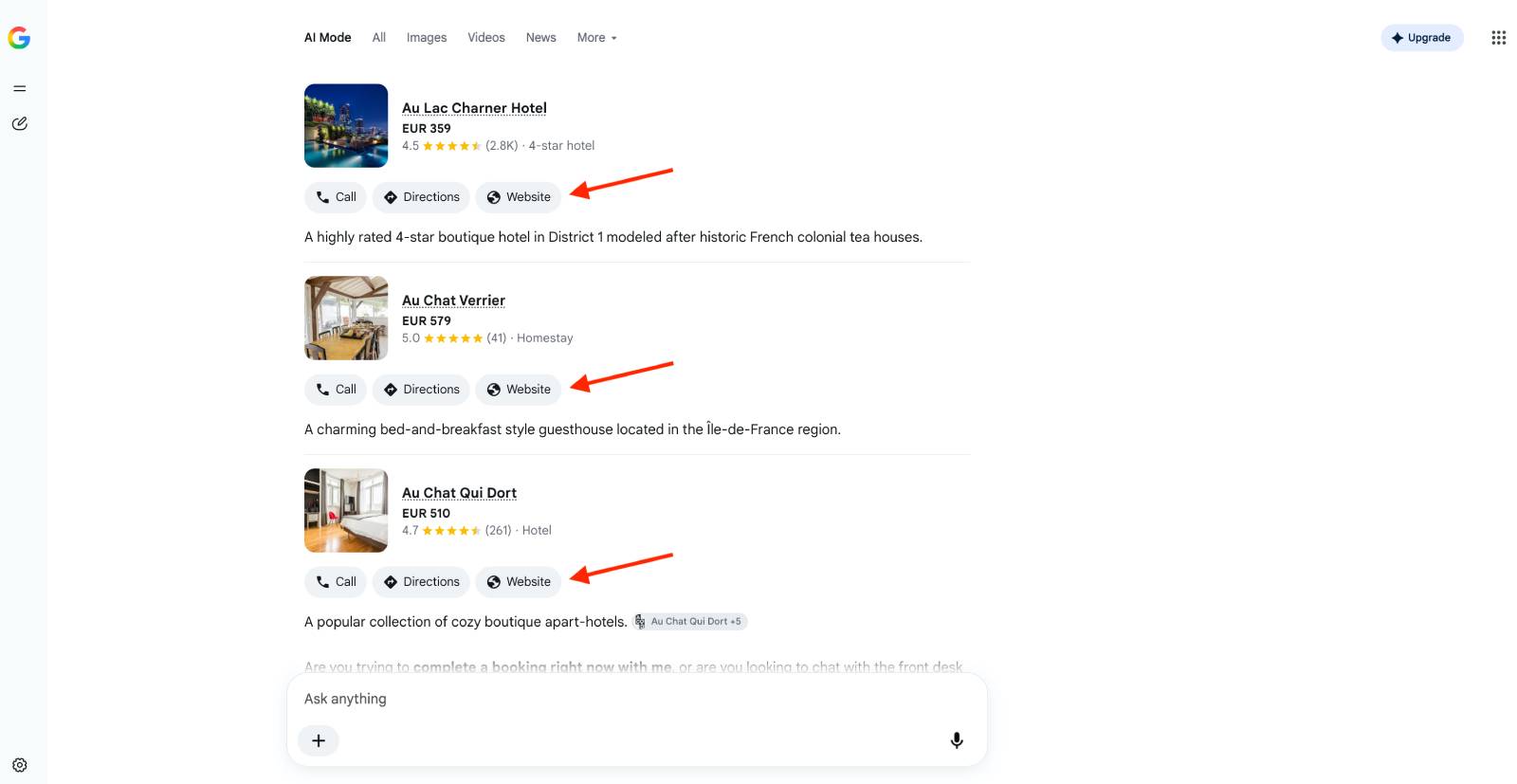
However, many travelers can also use AI to build and refine an entire trip in one conversation – with external tools and plugins, not a mere chat.
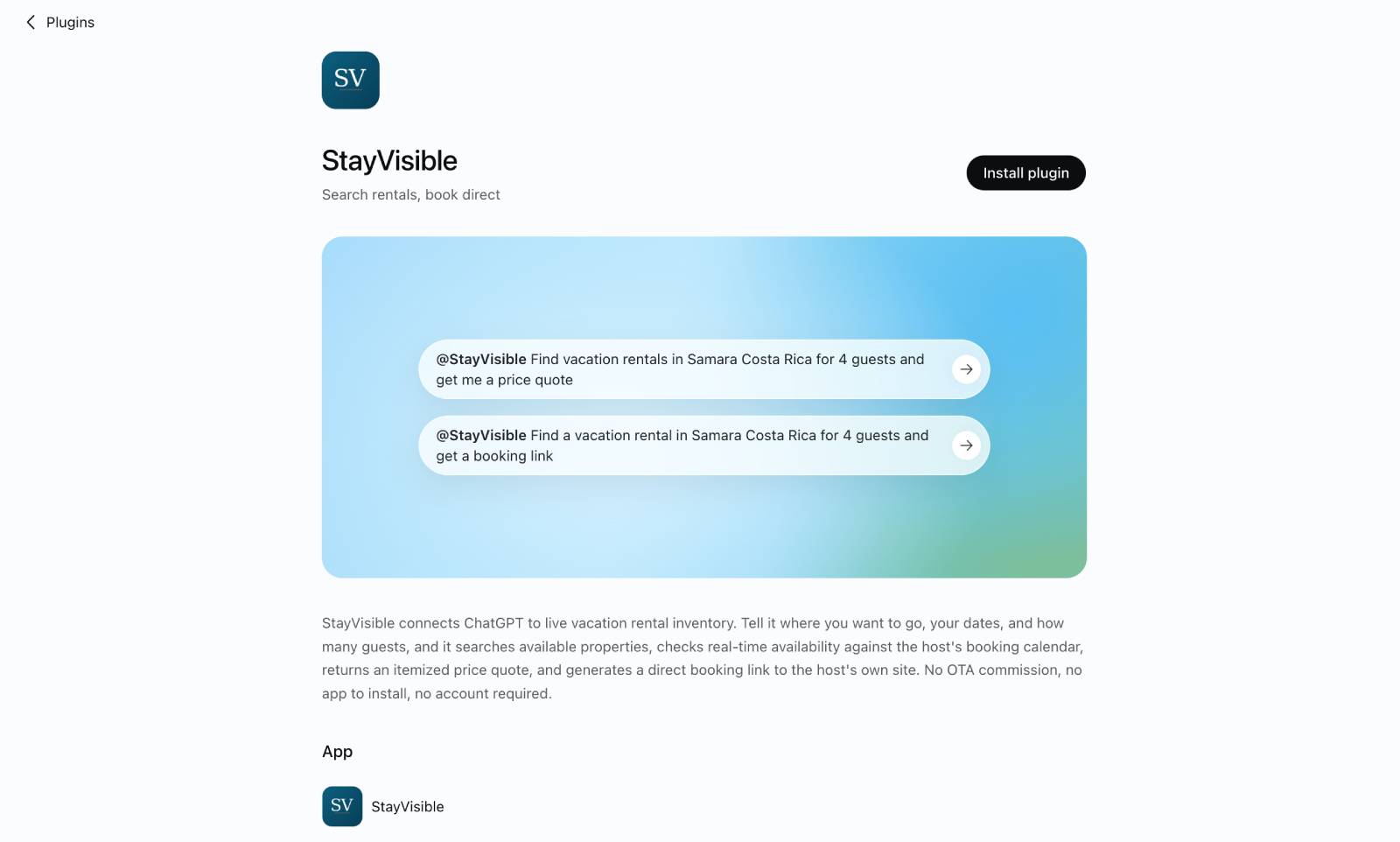
In ChatGPT, there are many plugins that users can install and plan trips easier with contextual help: StayVisile, TripCanvas, and more.
Another example is Google’s AI Mode + Canvas, which can create an interactive travel plan that brings together destinations, accommodation, activities, and other trip details. Travel planning with Canvas is available on desktop in the U.S. for those opted into the AI Mode experiment in Labs.
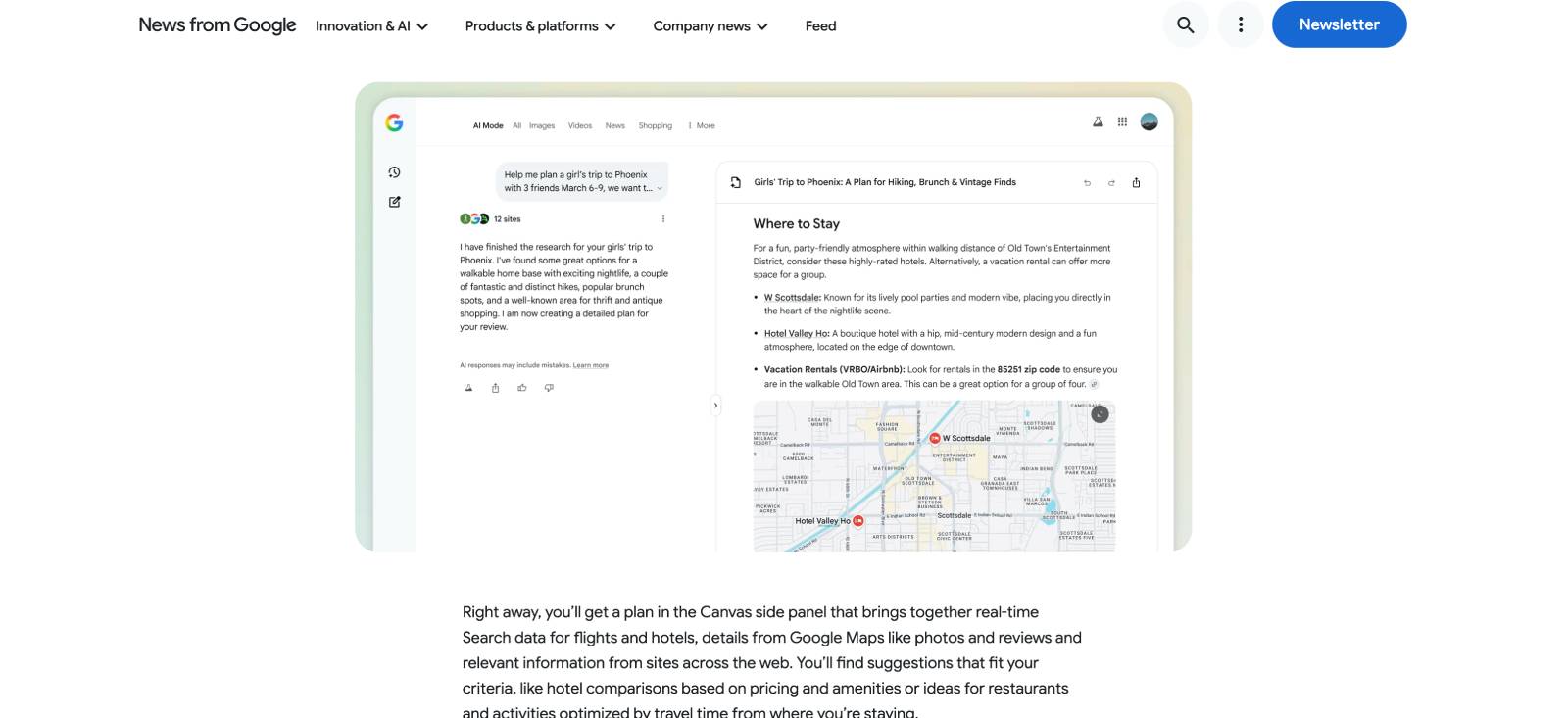
An entire ecosystem of AI helpers for trip planning makes the whole idea of AI convenience for this goal even more attractive.
For property owners, this makes AI visibility relevant even before a traveler searches specifically for a hotel or vacation rental. Your property could become part of the travel plan while the guest is still deciding where to go, where to stay, and what to do.
What travelers actually ask AI
The important thing for an accommodation owner is that travelers aren’t necessarily starting with:
“Find me a hotel in Barcelona.”
They can start much earlier in the decision process:
- “Where should I go in Greece in September if I want warm weather but fewer crowds?”
- “What’s the best area to stay in Mallorca for a family without a car?”
- “Find me a quiet beach town near Barcelona for a long weekend.”
- “Where should I stay in Rome if I want to walk everywhere?”
- “Find a vacation rental for two families with a pool near the beach.”
- “What are the best things to do around Split for 5 days?”
- “Which neighborhoods are best for a couple who wants restaurants and nightlife but not a party area?”
The AI can then narrow down destinations, neighborhoods, and types of accommodation before the traveler ever visits an individual property’s website.
Google’s Gemini, for example, can combine information from Google Maps, Hotels, Flights, YouTube, and a user’s own information to build personalized itineraries. If you clearly communicate the specific benefits and value of your neighborhood, and they match the traveler’s questions, it becomes easier for an AI tool to recommend your property with a direct booking website link.
Concluding: The main things to know
– AI is not yet the primary way most travelers book accommodation.
Many travelers still rely on familiar brands, OTAs, Google, and the websites they already trust when it comes to making a booking. However, AI tools such as ChatGPT and Google AI are becoming an increasingly important part of the research and planning stage.
– The main advantage of AI is convenience for travelers.
Instead of browsing dozens of websites, applying filters, comparing properties, and checking different sources, travelers can describe what they need in their own words and get a shortlist or personalized suggestions much faster. AI can reduce the information overload and mental effort involved in planning a trip. It’s not a mere chat anymore – there are many specific ‘add-ons’ for specific travel purposes.
– People can search for things even when they don’t know the right terminology.
Instead of first learning the name of a concept, they can describe what they mean and let search help identify it.
– AI is becoming part of the entire travel-planning process.
Travelers can use AI not only to find a destination or accommodation, but also to build itineraries, find restaurants and activities, compare options, and refine their plans through follow-up questions. The big travel platforms are already moving in this direction. Companies such as Booking.com, Expedia, Google and others are integrating travel search, accommodation data, prices, availability, reviews and booking functionality into AI-powered experiences. The direction is clear: the conversation that starts with “Where should I stay?” can increasingly lead all the way to “Book this for me”.
– For a direct booking website, being recommended by AI may become as important as being found in traditional search.
If travelers increasingly discover properties through AI conversations, being absent from those recommendations means missing a potential source of guests. And as AI platforms add booking capabilities, being discovered there could eventually lead directly to a booking.
– Travelers also use AI to find official property websites.
Many already know that booking direct can sometimes mean lower rates, better deals, or extra value, so they may ask ChatGPT or similar tools to find direct booking options in a specific location.
– Travelers are moving beyond keyword-based searches.
They’re asking more detailed, natural-language questions that reflect their real needs, preferences, and the kind of stay they want. This shift in search behavior matters when making your property discoverable through AI.
– Independent properties should not ignore AI search.
Learning how AI systems discover and understand properties can help owners build a stronger foundation before AI-driven travel discovery becomes more competitive. The goal is not to “rank first in ChatGPT,” because there is no simple ranking system like traditional search. The goal is to make your property easy for AI to discover, understand, verify and match with the right traveler.
– Clear information and distinctive information serve different purposes.
Accurate descriptions of facilities and location help explain what a property offers. First-hand details about the experience can give travelers additional reasons to consider it.