
Table of Contents
What you’ll learn:
You’ll learn what GEO/AEO means, why AI-powered travel discovery matters for your direct booking website, how major travel platforms are adapting, and why you should help AI tools discover your property and recommend it to the right guests.
Key takeaway:
The vacation rental and hotel booking journey has fundamentally shifted from a linear path to a fragmented ecosystem with dozens of touchpoints: search engines, AI platforms, social platforms, and OTA sites. AI platforms offer a new, more convenient way for discovery, including for accommodation booking. If you want your property to be present in this discovery, you need to understand what AEO/GEO is and apply its key tips to your website.
What is GEO/AEO?
Historically, when optimizing a website for visibility on the internet, meaning aiming to be found by potential customers online, we talked about SEO. SEO stands for Search Engine Optimization.
The new terms, which are often used interchangeably, GEO (Generative Engine Optimization) and AEO (Answer Engine Optimization), emerged with the growing popularity of big LLMs (Large Language Model) like ChatGPT, Perplexity, and Google’s Gemini. Sometimes you’ll see these models referred to as GenAI, hence, the GenAI optimization term is also quite widespread.
Basically, traditional SEO deals with Google, Bing, Yahoo, and other search engines people use, while GEO/AEO deal with the new search platforms. The reason is that the way people search and get answers differs significantly between search engines like Google and LLMs like ChatGPT.
This means we can talk about different working principles, optimization tips, and optimization approaches within SEO and AEO.
This also doesn’t mean that you should forget your SEO efforts. SEO and AEO work together and have many overlapping moments.
What are you actually optimizing for with AEO/GEO?
An LLM is not a knowledge database like Wikipedia or a search index like Google. It doesn’t store facts in a neatly organized library or have a direct understanding of the world. Instead, it learns statistical patterns from training data, representing language through numerical parameters and relationships between tokens.
When generating an answer, an LLM predicts which tokens are likely to come next based on the context and patterns it has learned. It can produce remarkably coherent explanations, but it can also make mistakes, reproduce outdated information, or confidently state something that isn’t true.
When AI tools use external sources, such as websites, reviews, and search results, they can incorporate that information into their answers. The model uses its learned patterns to interpret the context and generate a response, while retrieval systems provide access to relevant external information.
With AEO/GEO, you’re not simply trying to add information to an AI knowledge base. You’re making your property’s information clear, relevant, credible, and accessible to the systems that retrieve and synthesize language patterns when answering travelers’ questions.
Why should an accommodation booking website care?
Travelers extensively use ChatGPT and other AI tools to plan trips, book hotels, and build itineraries.
So, the first decision happens before the booking – and the trend to make those decisions inside LLMs is growing.
Imagine a traveler searching:
“I’m going to Crete with my partner in September. We want a quiet area, beautiful beaches, good restaurants nearby and somewhere that doesn’t feel too touristy. Where should we stay?”
If AI recommends three towns and five properties, those recommendations have already influenced the traveler’s shortlist.
The traveler may never see the other 200 properties that could have appeared in a traditional search.
That’s why where people search matters.
If your potential guests are searching Google, you care about Google visibility.
If they are searching Booking.com, you care about OTA visibility.
If they are asking ChatGPT or Gemini, you increasingly need to care about whether these systems can discover, understand and recommend your property; provide links to your direct booking site and show your availability / rates in real time.
Moreover, if you ever tried to buy Google ads to promote your property when people search in Google, now with the shift to AI chats, you may want to buy the Direct Offers ads that run your ads inside AI mode.
Large travel platforms are actively putting their inventory inside AI experiences
Travelers are increasingly turning to AI tools to plan trips and find accommodation, flights, car rentals, and activities.
Major OTAs and search engines are already integrating with AI tools in different ways because that’s where their potential customers are.
Booking.com
Booking.com has been working with OpenAI to bring its property data, pricing, availability, reviews, and other information into AI-powered travel experiences.
Its collaboration with OpenAI includes an AI Trip Planner (called Dot, normally accessible from mobile apps in specific regions with English selected in the settings), natural-language search, Smart Filters, and property Q&A. Booking.com specifically describes the opportunity as reaching travelers earlier in the discovery process, before they know exactly what they want.
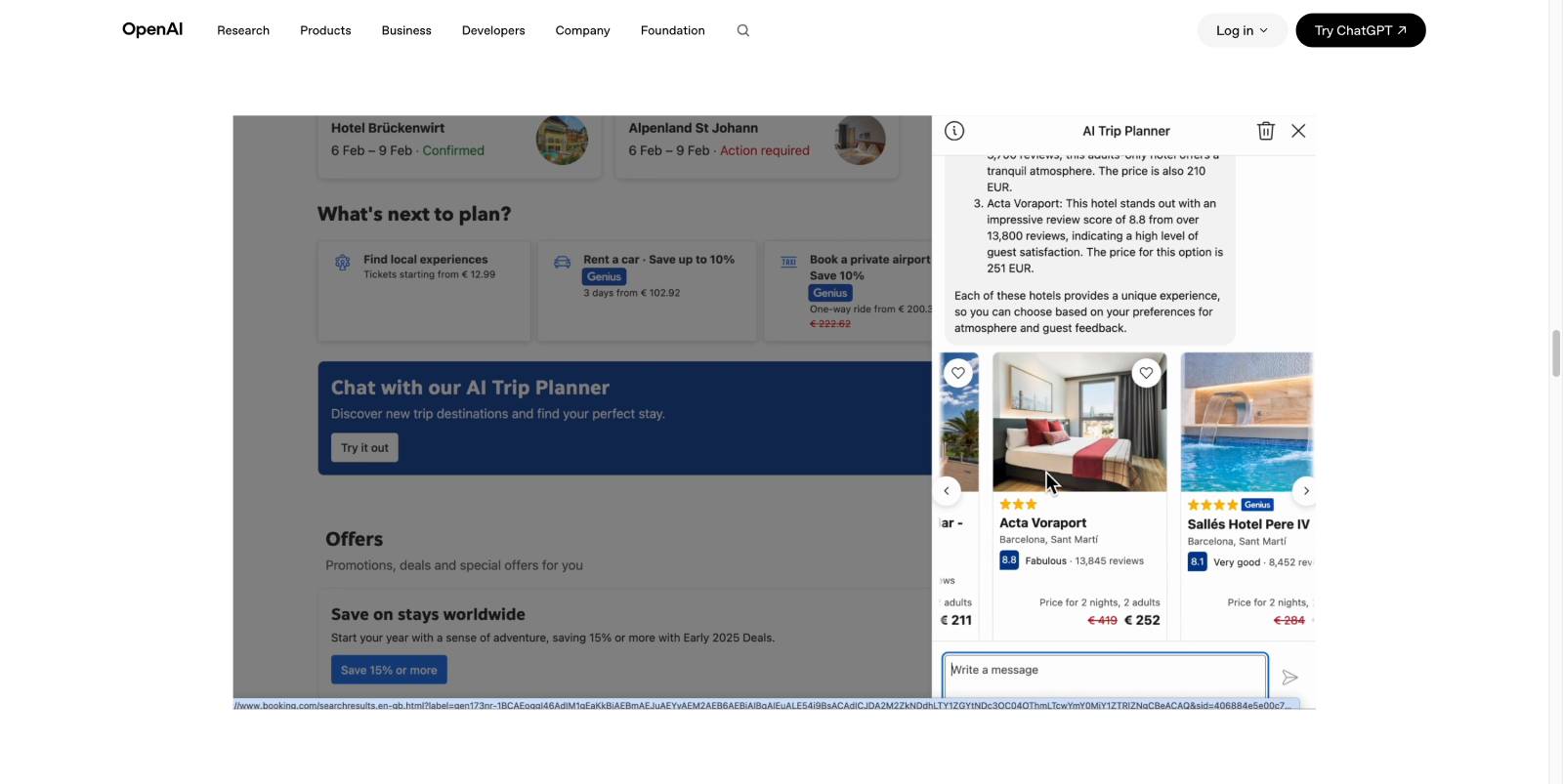
In other words, understanding that travelers plan trips with AI, Booking.com is trying to show that an AI conversation is possible right within its platform, with probably better results thanks to deeper integration with the platform.
Expedia
Expedia has taken an even more direct route.
It launched an Expedia app inside ChatGPT, allowing travelers to ask for hotels and flights and receive dynamic prices, availability, maps, and other travel information directly in the conversation. The traveler can then continue to Expedia to complete the booking.
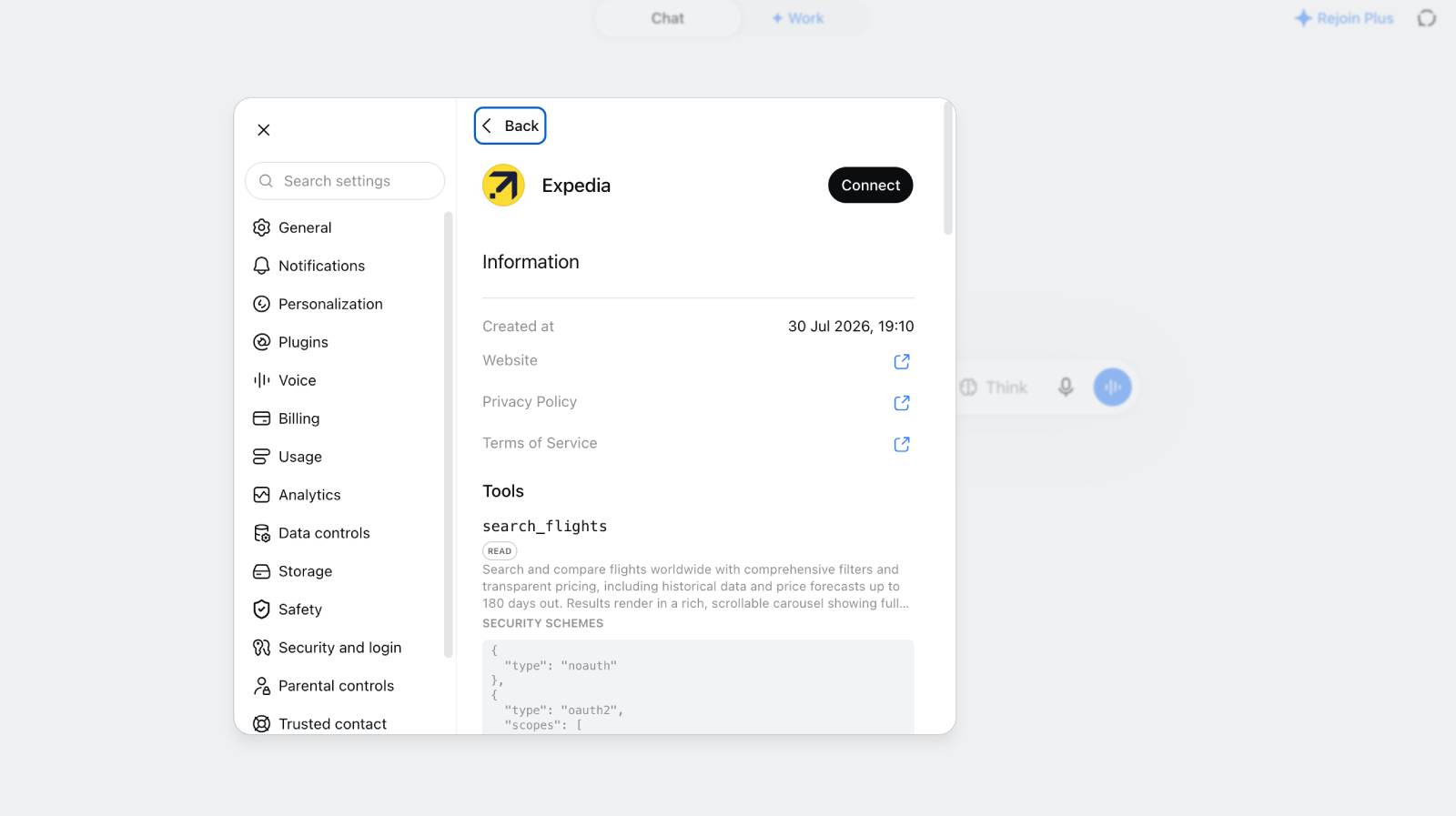
Expedia also explicitly said that it was expanding its discovery beyond its own platforms because there was a gap between people discussing travel on GenAI platforms and actually booking with a travel brand. Its OpenAI and Microsoft integrations were intended to bridge that gap.
Google is going even further by integrating travel planning and booking directly into AI-powered Search. This means guests can book and pay without leaving an AI chat, with natural-language instructions.
Its AI Mode can compare hotels, use real-time information and, as of August 2026, enable hotel booking directly through an AI-assisted conversation.
And Google’s advertising products are also moving into this environment: Google has announced that travel partners such as Booking.com and Expedia will be able to surface special offers inside AI-assisted trip planning.
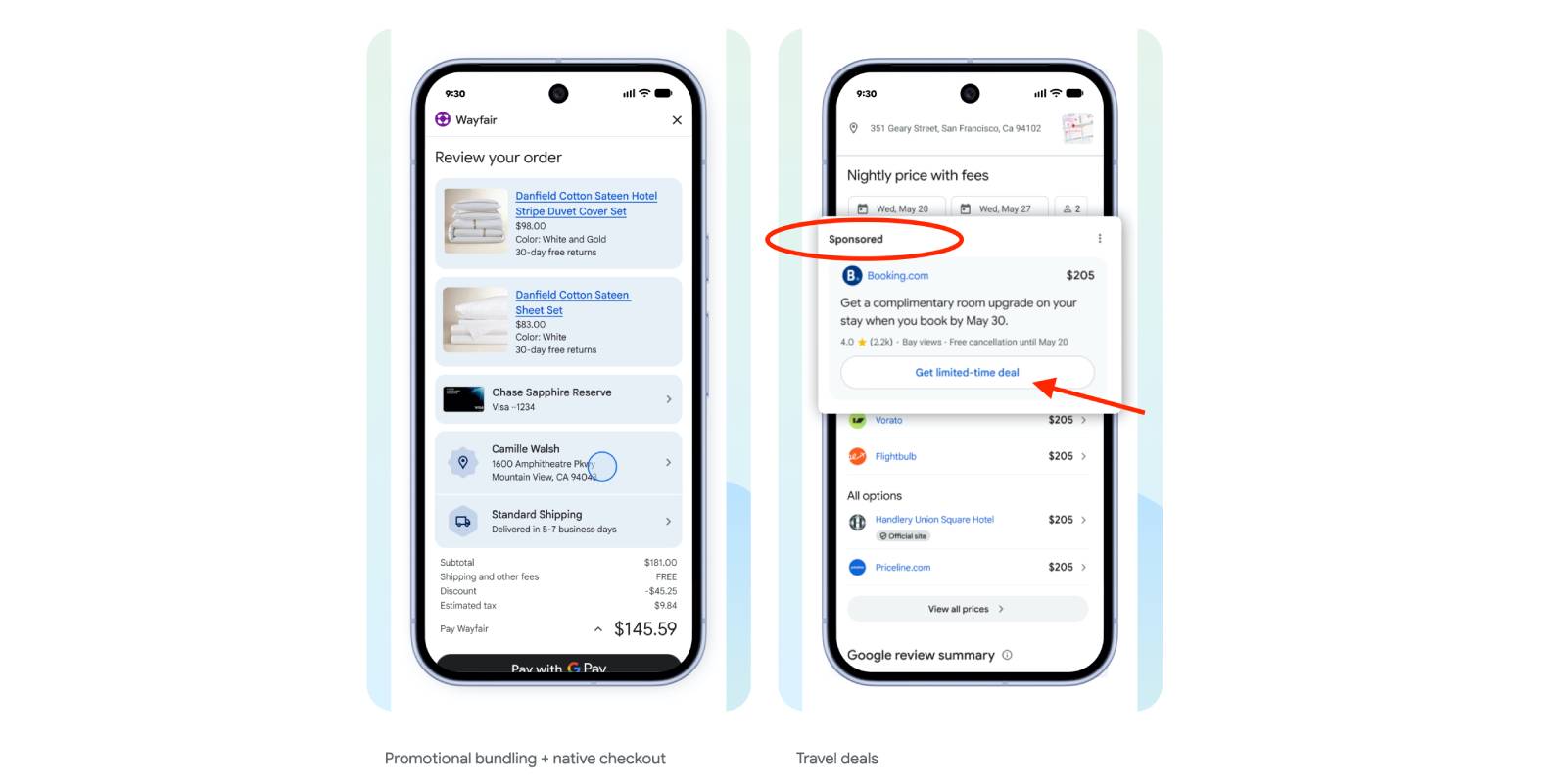
As a direct booking website owner, you should consider optimizing your website to be discovered in these AI conversations, just as you do for traditional Google searches. The goal is to make your property visible wherever potential guests look for their next stay.
That doesn’t mean you should launch a full-scale integration with GenAI providers (OpenAI, Google Gemini, etc.) just like OTAs. However, there are different ways GenAI helps smaller properties get discovered by using more factors to better match them with the right guests. That works even better with GenAI/AEO optimization.
Traveler personas matter more in AI search
AI search is changing how you need to understand your potential guests. Now you don’t just need more detailed personas – you need more of them overall.
Travelers increasingly describe their specific circumstances, preferences, and expectations when asking AI to recommend a place to stay.
The more specific these requests become, the more important it is for you to understand who your ideal guests are, what they need, and what makes your property a good match for them.
You can distinguish between two types of traveler personas:
– Stable personas: Guest groups with relatively consistent needs throughout the year, such as families looking for child-friendly facilities, remote workers who need reliable Wi-Fi, or couples seeking a quiet getaway.
– Situational personas: Guest groups whose needs depend on a particular season, event, trip purpose, or circumstance. For example, visitors attending a local festival, travelers looking for a winter escape, or families seeking accommodation near a specific sports venue.
These personas should influence more than your marketing campaigns. Use them to decide what information to publish about your property, which amenities to emphasize, what questions to answer in your FAQs, and how to describe your location and surrounding area. The same property may appeal to several distinct guest profiles, each looking for different reasons to book a stay.
Why does this matter for GEO/AEO? AI search can connect detailed traveler requests with specific property attributes and contextual information. The better you understand the situations in which your accommodation is a relevant choice, the easier it becomes to create content that reflects those needs and helps AI systems recognize the connection.
You don’t need to create content for every imaginable traveler. Focus on the guest profiles most relevant to your property, and communicate clearly why your accommodation suits their particular needs.
Can a small property actually appear in ChatGPT or Gemini?
The competition is huge, and the list of options GenAI chats curate is normally limited.
However, yes, an independent property can become visible in AI-generated recommendations, but there is no guaranteed ranking position like there is in a traditional search result.
AI recommendations are generated dynamically based on the question, location, dates, traveler preferences, LLM model, available information, and the sources the AI system can access.
The key thing that LLM creators state: AI is non-deterministic, which in practice means two different people may get different answers to the same question based on the parameters we’ve just listed.
And there are even more limitations. AI systems can:
- use different sources for different queries;
- change recommendations from one conversation to another;
- have incomplete or outdated information;
- misunderstand a property;
- favor businesses with stronger online signals;
- rely heavily on reviews and third-party information;
- recommend an OTA instead of the property’s own website;
- fail to mention a perfectly suitable property.
Expedia itself warns that its ChatGPT experience can occasionally contain inaccurate or outdated information.
So AI visibility is not a new version of “rank #1 on Google” in your location. However, with manual interaction, there are many ways to optimize your website for AI systems to discover, understand, verify, and match with the right traveler.
You don’t need to compete with Booking.com or Airbnb. You need to make it easy for AI to understand why your particular property is the right answer to a particular traveler’s question.
Concluding: The main things to know
– AI isn’t a library you can add information to.
LLMs use statistical patterns learned from text to generate answers rather than retrieve facts from a fixed knowledge library. When AI tools search the web, they can also draw on external sources to answer travelers’ questions.
– AI search changes how information is retrieved, not the need for useful information.
AI tools retrieve and synthesise material from search results. But there is no special content format or a particular GEO technique guarantees inclusion in AI answers.
– AEO is just as important for an accommodation business as SEO.
The search technology is changing and you want your property website to be discoverable across AI conversations where travelers plan trips, book hotels, rent cars, and search for activities.
– Big OTA are working on a mix of direct AI integrations and indirect AEO.
In the past, OTAs could only match a traveller to the property based on basic factors like dates, location and simple features. Now, GenAI allows us to use more factors, which you can also use to optimize your independent accommodation website for better visibility.
– AI optimization is an extension of your existing marketing efforts and SEO.
A well-structured website, clear property descriptions, useful content, accurate details, and a strong online presence can support both traditional search visibility and discovery through AI tools.
– Traveler personas are becoming more detailed.
Travelers are moving beyond simple keywords to describe specific needs, preferences, and travel scenarios. Broad categories like families or couples no longer capture the full range of reasons people choose accommodation.