
Table of Contents
What you’ll learn:
You’ll learn how travelers use Google’s maps, property profiles, hotel price comparisons, organic results, and AI features to explore accommodation. You’ll understand how these experiences can influence a booking before someone visits your website and why visibility on Google and a strong direct booking website serve complementary roles.
Key takeaway:
Guests can learn about your property, assess its location, and compare booking options before reaching your website. Your presence across Google helps shape that first impression. Clear property information, accurate booking details, and an accessible direct booking option help travelers move from considering your accommodation to making a reservation.
The shift from blue links to the Google Travel Ecosystem
Historically, a traveler would type “places to stay in Miami,” click on a hotel’s website, and browse. Today, Google’s goal is to keep the user on Google for as long as possible. When a traveler searches for accommodation, they are instantly met with a rich interface featuring interactive maps, date selectors, and price comparisons.
With travelers overwhelmed by infinite choices, Google attempts to reduce “comparison fatigue” by bringing all the necessary data to the surface. How travelers actually navigate this ecosystem today:
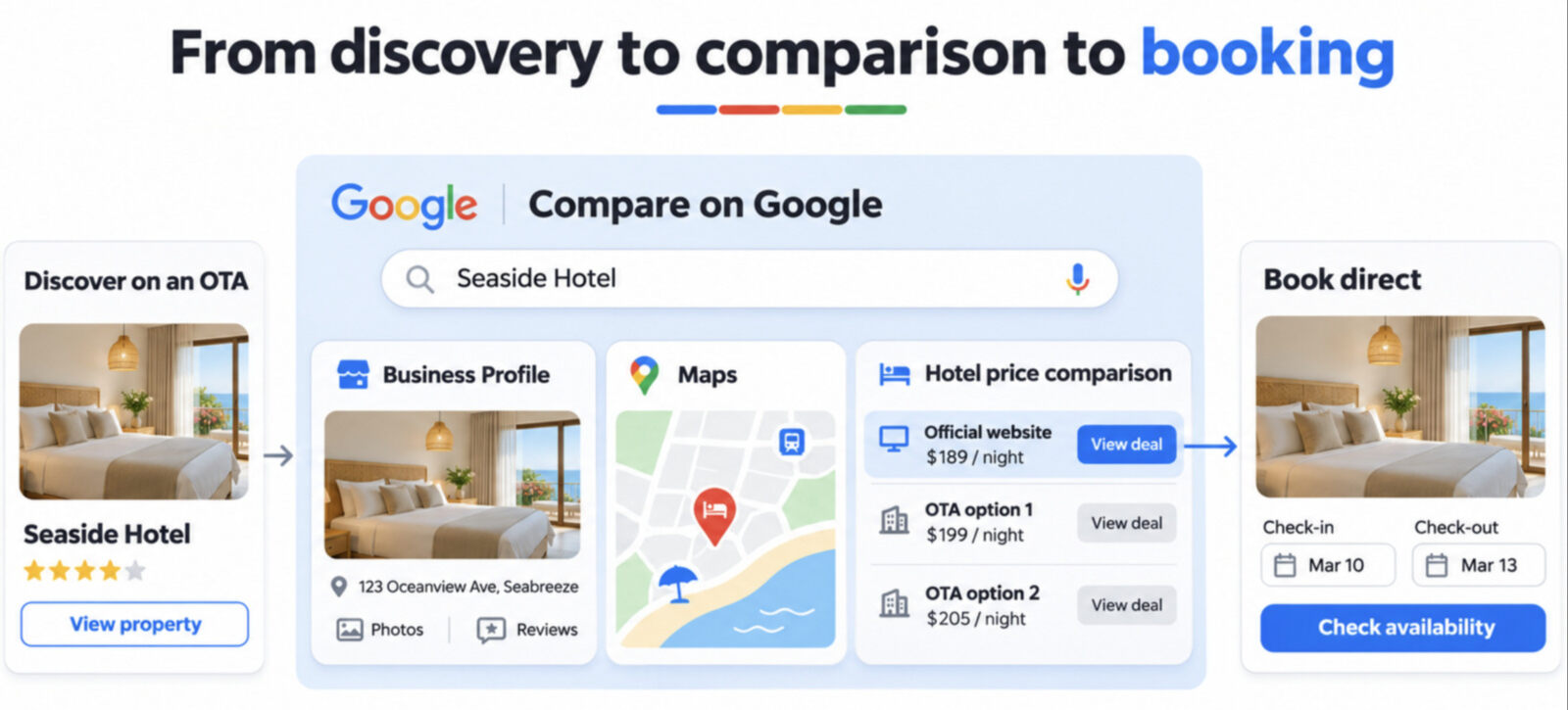
- Broad Search & Map Exploration: The traveler searches “hotels near Colosseum Rome.” They don’t look at website links; they immediately click the Google Maps widget to visually browse locations and prices.
- Review Checking: They click on a specific property on the map to open its Google Business Profile. They read the first 5-10 reviews and look at guest-uploaded photos.
- Price Comparison: They scroll down to the “Prices” section (Google Hotel Center) to see who offers the best rate: Booking.com, Expedia, or the Official Website.
- The Click-Through: If the official website has a competitive rate and a complete profile, the traveler will finally click “Website” to book directly.
The Mechanics of Google Accommodation Search
Despite the rise of AI, the core visual surfaces of Google’s travel ecosystem still dictate how most travelers find properties. When a traveler searches for accommodation natively on Google, here is exactly what happens:
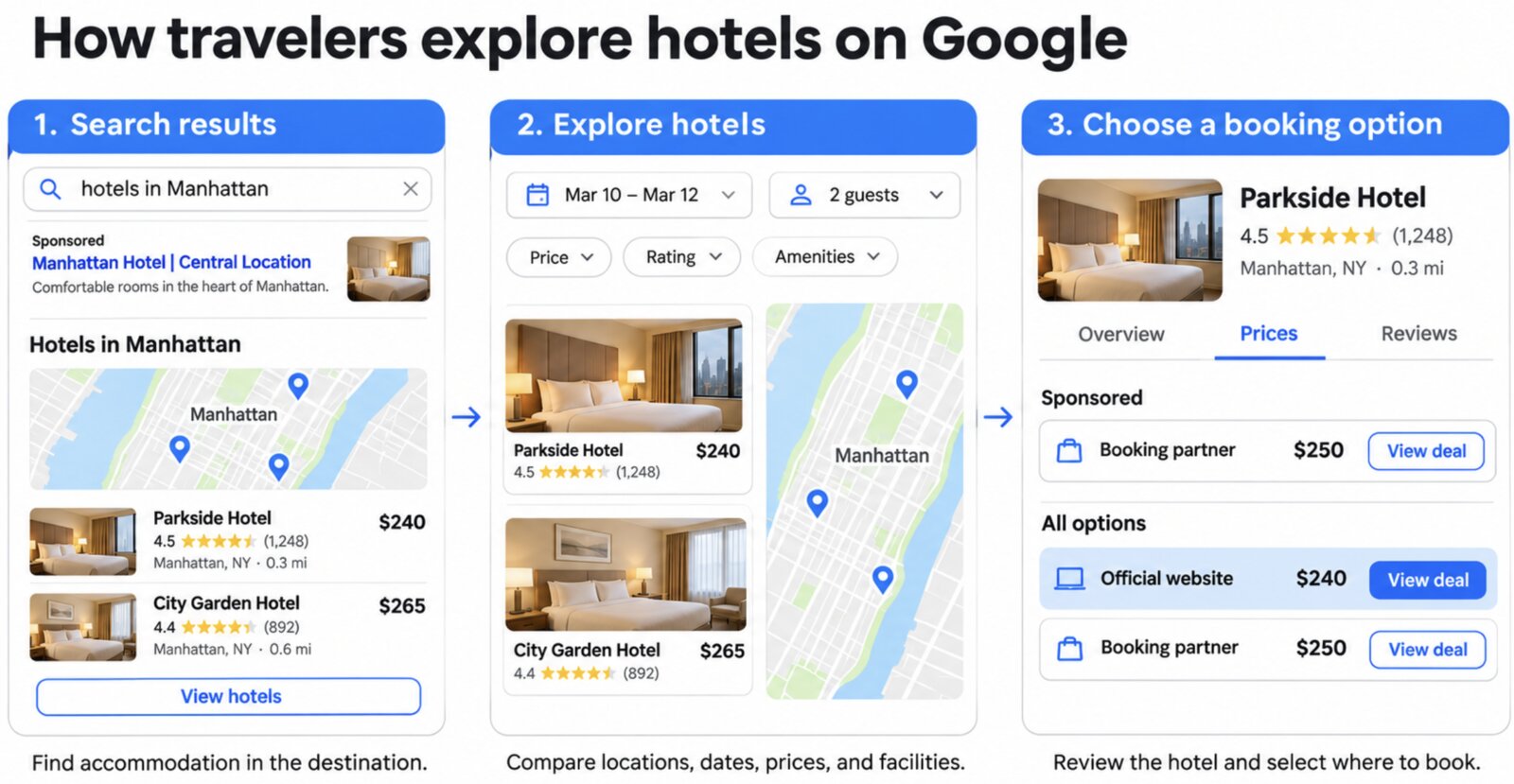
- The Search Results Page: Travelers are presented with a mixture of ads (marked with an “Ads” badge) and free booking links. A specific “hotel pack” usually appears, featuring a map and a short list of top results.
- Hotel Results Deeper Dive: When a traveler clicks “View hotels” or taps the map, they are taken to a complete list of results. This view includes photos, prices, and ratings. The price shown is aggregated across all partners. Here, travelers apply strict filters based on check-in dates, occupancy, price, and amenities.
- The Hotel Details Page & Booking Module: Clicking a specific hotel opens its details page, containing contact info, reviews, and the critical “booking module.” This module displays Paid Hotel Ads alongside “All options” (Google Free Booking Links), allowing travelers to pick exactly which channel they want to use to reserve a room.
The Rise of Zero-Click Search
According to Similarweb’s 2026 report, zero-click searches, queries that end without a user clicking through to any website, now represent 68% of all Google searches.
Instead of showing a list of links, Google is moving toward delivering answers, surfacing the one or two properties that best match the request right on the search page.
At the center of this shift is what many call “agent-led shopping.” Google is no longer just helping users explore options; it is actively narrowing them down and influencing the final choice. By owning the discovery phase, it’s inserting itself as a dominant layer that sits directly between the traveler and every booking channel.
Booking Directly within AI Mode
In August 2026, the traveler journey shifted again. Google announced that travelers can now search for, select, and book a hotel through a single conversation using AI Mode in Search.
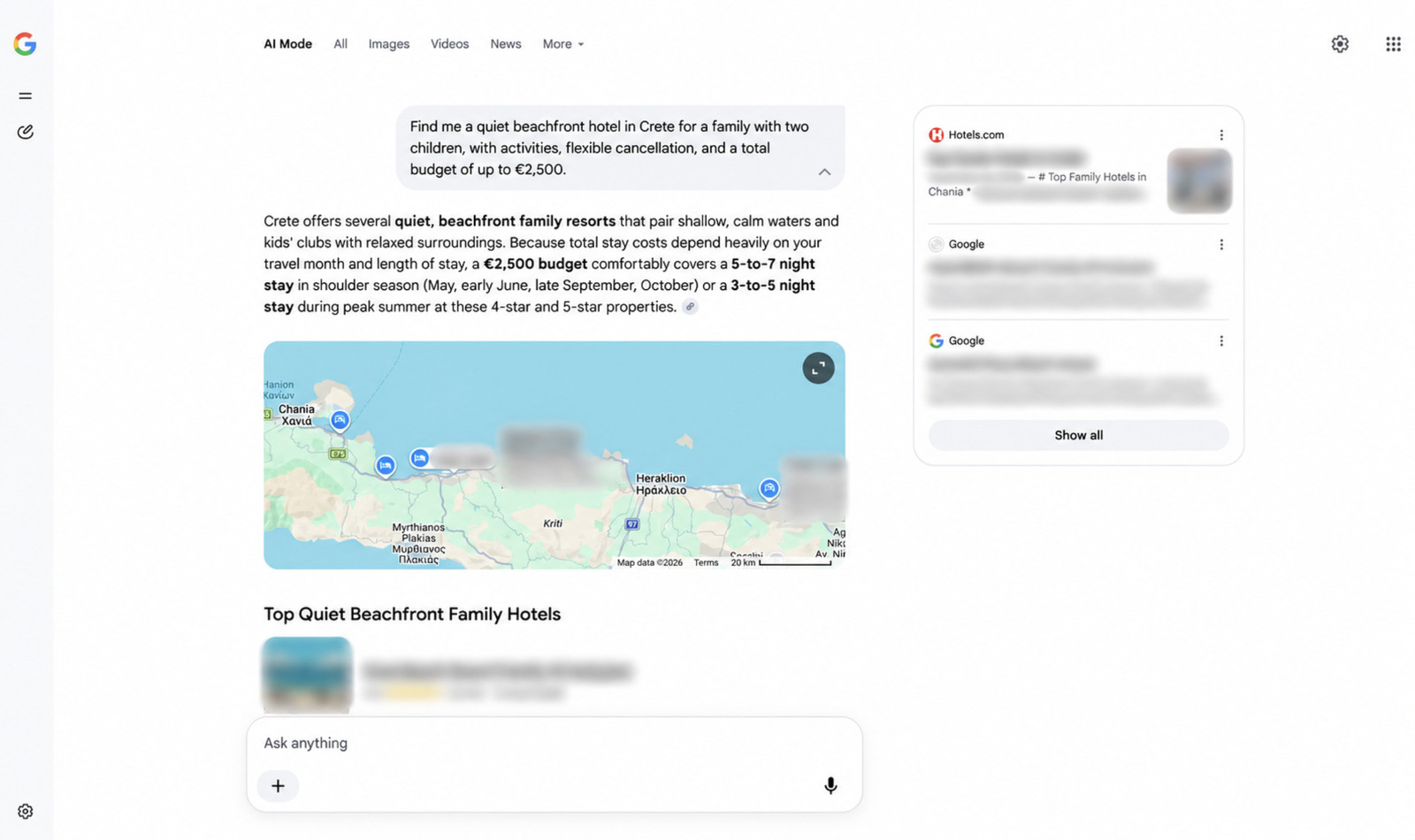
With AI Mode, Google is evolving into a digital travel advisor. Travelers no longer need to perform multiple searches or apply manual filters.
They can simply type:
“Find me a quiet beachfront hotel in Crete for a family with two children, with activities, flexible cancellation, and a total budget of up to €2,500.”
The AI interprets the complete intent and performs parallel searches across prices, locations, amenities, and reviews. Once the user finds the right hotel, they can select “Continue on Google” to pick a room type and complete the reservation securely via Google Pay.
The hotel or booking platform remains the merchant of record and handles customer service, but the traveler’s entire shopping experience happens without ever visiting an external website.
Understanding traveler behavior across Google tools
Because travelers cross-reference properties endlessly, you should maintain a perfect presence across all of Google’s primary surfaces.
| Google Surface | Traveler Behavior | Why it matters to your direct bookings |
|---|---|---|
| Google Maps | Travelers use this to verify spatial context, checking walking distances to transit, restaurants, or the beach. | Your map pin must be exact. If a guest thinks you are further from the center than you actually are, they will abandon the booking. |
| Google Business Profile (GBP) | Travelers use this to gauge trust. They check recent reviews, Q&A sections, and look for red flags in management responses. | An incomplete profile signals an unprofessional business. Responding to reviews and updating amenities is non-negotiable. |
| Google Hotel Search (Free Booking Links) | Travelers use this strictly for price shopping. They want to see the cheapest available channel. | If your direct rate isn’t listed here alongside the OTAs, the traveler assumes booking direct is either impossible or more expensive. |
| Google Hotel Ads (Paid Search) | Travelers look at the very top of the price comparison module where sponsored, highlighted properties appear. | Bidding on your own brand name or running targeted paid ads ensures your direct site outranks OTAs right when high-intent bookers are ready to pay. |
| Traditional Search (Organic Links) | Travelers use this for deep research and verification when looking for direct options. | When guests use search engines to find your official website as an independent option, your organic presence and direct links must capture them before they bounce. |
| Google AI Mode / Search | Travelers use conversational prompts to discover attributes, check price tracking alerts, and explore auto-assembled itineraries. | Structured data and clear property details ensure Google’s AI tools accurately recommend your property in conversational search results. |
What this all means for property owners
As direct booking is redefined by AI, zero-click searches, and curated answers, your strategy must evolve beyond traditional SEO.
- Zero-Click Marketing: If you evaluate your hotel’s digital marketing purely by website traffic, your metrics are telling an incomplete story. Zero-click does not mean zero influence; it means the influence happened entirely on Google’s search page.
- Visibility vs. Eligibility: Ranking on page one is no longer the end goal. Google prioritizes structured data, consistency, and trust signals to confidently recommend a property. If your pricing, availability, or reviews are fragmented across the web, you are less likely to be selected, even if you technically rank for the keyword. Optimization is now about eligibility.
- Content Must Remove Uncertainty: As Google takes on more decision-making, it relies heavily on clear, direct information.
- The Risk of Losing Control: If Google becomes the primary decision-maker, properties risk losing control over how guests discover them. A flawless direct booking setup is your best defense against this new layer of dependency.
Related Guide:
- Optimize your accommodation/property pages for search
Concluding: The main things to know
– Google offers several routes to discovering your property.
By providing curated recommendations and agent-led shopping, Google is actively influencing which property a traveler chooses, rather than just showing them options.
– Booking direct no longer guarantees a website visit.
Accommodation searches can lead travelers through maps, hotel listings, reviews, price comparisons, AI answers, and website links. Understanding their roles gives you a fuller picture of how guests encounter and evaluate your business.
– A guest’s first impression may form before a website visit.
Photos, reviews, location details, and amenities can influence whether your property makes the shortlist. Your website may enter the journey after a traveler has already formed expectations. Accurate information across these sources helps guests recognize the same property and understand what it offers.
– Choosing a property and choosing a booking channel are separate decisions.
A traveler can decide to stay with you and still compare your official website with several OTAs. The total price, room type, cancellation terms, payment conditions, and confidence in the provider can all affect that choice. A visible direct booking option gives guests another route to reserve, while a clear offer helps them evaluate it.
– Website traffic captures only part of your visibility.
Travelers may read reviews, examine the map, or compare prices without clicking through to your site during that search. Those interactions can still contribute to a later decision. Website visits remain useful, but they need to be considered alongside enquiries, reservations, and the channels through which guests book.
– AI makes specific, reliable property information especially useful.
Conversational searches allow travelers to describe several requirements at once, such as a quiet location, family facilities, and flexible cancellation. Clear descriptions help both travelers and search systems understand whether your accommodation fits. Structured data can support that understanding, but it does not guarantee an AI recommendation or booking.
– Your own website remains an important part of the booking journey.
Your website gives you space to explain room differences, policies, local knowledge, and direct booking benefits in detail. It also provides a place to establish a direct relationship with the guest. As Google’s interfaces evolve, keeping that experience clear and easy to use helps you make the most of the interest generated elsewhere.