
Free Vacation Rental Agreement Template: Tips & Examples
Table of Contents
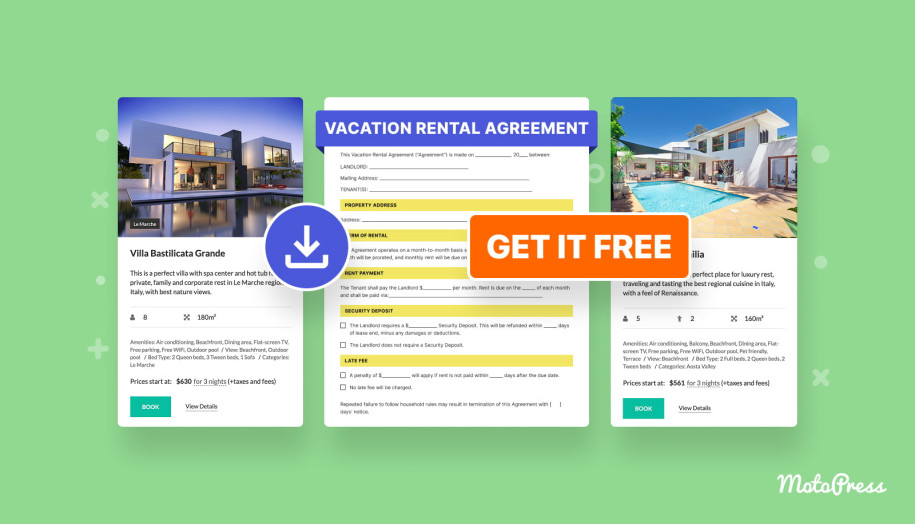
There are still quite a few things you and your guest should agree on before they walk through the door. Who can stay at the property? Can they bring a pet, invite friends over, or cancel a week before arrival? And, perhaps most importantly, where are all these rules actually written down? That’s where vacation rental agreements come in handy. If you’re looking for a vacation rental agreement template you can quickly adapt to your property, you’ll find one further down this guide!
But I don’t want to simply hand you a document full of blanks to fill in. We’ll first go over what’s worth putting into an agreement, which details are easy to overlook, and how to make the final version work for your particular rental. Let’s get it started!
What Is a Vacation Rental Agreement?
In simple terms, a vacation rental agreement is a document that lays out the conditions under which a guest can stay at your property for a specified period.
Think of it as putting the details you’ve already discussed or would otherwise have to explain one by one in one place. It’s sometimes also called ‘short term rental lease agreement’.
Exactly what should go into yours will depend on the property, how you take bookings, and the rules that apply where your rental is located. That’s why I’d treat any ready-made template, including the one in this article, as a starting point.
Do I Really Need a Short-Term Rental Agreement?

Imagine a guest books for four people and arrives with six. Or someone assumes pets are welcome because they didn’t see a rule saying otherwise. Perhaps a cancellation comes in at the last minute, and the guest expects a full refund, even though your policy says otherwise.
These are exactly the situations where “I thought…” and “I assumed…” start creeping into the conversation.
A short term vacation rental agreement helps get those assumptions out of the way before the stay begins.
It gives you somewhere to state the practical details of the booking clearly. At the same time, guests know what they are agreeing to before they pay and pack their bags.
That said, don’t fall into the opposite trap and add rules just for the sake of having more rules. A good vacation rental lease agreement should make the stay clearer, not more intimidating.
Once you know what needs to be covered, the next question is much easier to answer: what should actually go into it?


The Details I’d Include in a Vacation Rental Agreement

Now for the part that usually takes the most time: what do you actually put in the agreement? There are a handful of details I’d consider essential in almost any case.
Start with the Property and Host Details
Include the full name of the host, owner, or property manager, along with the rental property name and address.
Also, it would be handy to add your preferred contact details, particularly the phone number or email guests should use if they need to reach you during their stay.
Add the Guest Information
Next up, you need to ask about the primary guest’s full name and contact details. If your property and local requirements require it, you will need to include fields for the names of additional guests or any other relevant information about the people staying there.
Be Clear About the Dates and Check-In Times
Your dates may seem like the most obvious part of the agreement, but it’s worth being precise here. Put down the exact day the guest can arrive, when they need to leave, and the check-in and check-out times. So, rather than simply writing “September 14–17,” you might specify check-in from 3 PM on September 14 and check-out by 11 AM on September 17.
Perhaps guests let themselves in with a code, or they need to meet you to pick up the keys. Whatever the routine looks like at your rental, this is a good place to clear it up.
Spell Out the Price and Payment Terms
When it comes to money, the nightly rate is only part of the story. Give guests the number they really want to know: what will this stay cost me altogether? If there’s a cleaning fee, local tax, pet charge, or fee for an extra guest, put it on the table.
Then explain when payment is due. For example, do you collect the full amount when the reservation is made? A percentage upfront and the balance closer to arrival? Is there a deadline for the second payment?
A simple breakdown like this is often easier to understand than a long paragraph:
- Accommodation: $750
- Cleaning fee: $75
- Local taxes: $82.50
- Total: $907.50
- Deposit due at booking: $272.25
- Remaining balance due: September 30
Don’t Overlook the Security Deposit and Damage Policy
Regarding security deposit, state how much you charge, when it is collected, and when guests can expect it back.
Next, “You’ll be charged if anything goes wrong” leaves far too much room for interpretation. Think over different cases: damage beyond normal wear, missing items, excessive cleaning, or breaking specific property.
Make Your Cancellation Policy Easy to Understand
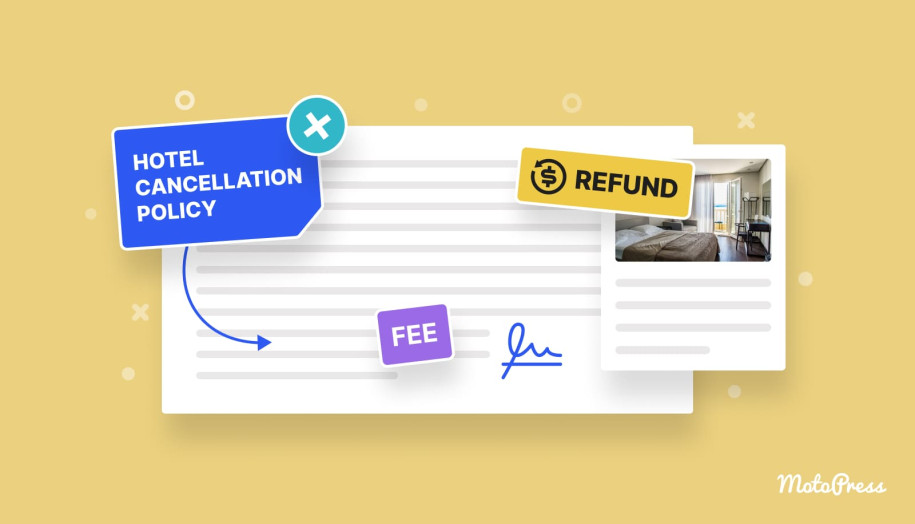
“Partial refund available” sounds clear enough until a guest actually needs to cancel. Partial means how much? And until when?
Put some numbers and dates behind the policy. You might return the full amount for cancellations made 30 days or more before arrival, cut that to 50% once the stay is 14-29 days away, and make bookings non-refundable during the final 14 days.
Set the House Rules Before Guests Arrive
Your house rules might cover:
- Smoking or vaping;
- Pets;
- Parties and events;
- Quiet hours;
- Parking;
- Use of pools, grills, fireplaces, or other amenities;
- Shared spaces.
Bonus Tip: Tone matters here more than you might think. House rules don’t have to sound like warnings. Compare “NO NOISE AFTER 11 PM!!!” with “Please keep noise down after 11 PM – we have neighbors nearby and would really appreciate your help keeping things quiet.” Same rule, very different welcome.
Clarify What the Host and Guest Are Responsible For (Optional)
Keep responsibilities in short term rental agreements simple and practical. Guests should know they’re expected to look after the property, report problems or damage, and follow basic safety rules.
Cover your side too. Who should they contact if something breaks? Can you or a maintenance person enter to fix an issue? A few clear lines here can prevent a lot of back-and-forth later.
Finish with Acceptance and Signatures
The agreement also needs a clear “yes, I agree” from the guest. On paper, that’s usually a signature and date. Are you sending it to the guest during online reservations? The same step can be handled digitally during checkout.
With those building blocks in place, we can finally put them together. Up next is a free short term rental agreement template you can copy, adjust, and use as a starting point for your own property.
Free Vacation Rental Agreement Template + Examples You Can Adapt
Below is a simple short term rental agreement template: anything in [brackets] is there for you to replace with your own information. You can also remove sections that don’t apply or add property-specific terms where needed.
Basic Vacation Rental Agreement Template
| VACATION RENTAL AGREEMENT |
|---|
| 1. Host and Guest |
| This Vacation Rental Agreement is made between: Host/Property Manager: [Full name] Contact information: [Phone number/email] and Primary Guest: [Full name] Contact information: [Phone number/email] The Primary Guest agrees to be responsible for the booking and for ensuring that all members of their group follow the terms of this agreement. |
| 2. Rental Property |
| Property name: [Property name, if applicable] Address: [Full property address] |
| 3. Rental Period |
| Check-in date: [Date]
Check-in time: [Time] Check-out date: [Date] Check-out time: [Time] Early check-in or late check-out: [Available/not available/available upon prior agreement with the Host] |
| 4. Guests and Occupancy |
| The reservation is for [number] guests. The maximum permitted occupancy is [number] people. Only guests included in the reservation may stay overnight at the property unless otherwise agreed with the Host. [Add your visitor policy here, if applicable.] |
| 5. Rental Price and Payment |
| Accommodation cost: [Amount]
Cleaning fee: [Amount]
Taxes: [Amount]
Additional fees: [Amount and description]
Total booking cost: [Amount] Payment terms: [Full payment at booking/deposit of X% at booking and remaining balance by DATE / other arrangement]. |
| 6. Security Deposit and Damage |
| A refundable security deposit of [Amount] is required [at booking/before arrival/upon arrival]. The deposit will be returned within [number] days after check-out, minus any applicable deductions for damage, missing items, or other charges covered by this agreement. Guests should report any damage or problems as soon as possible. |
| 7. Cancellation and Refunds |
| If the Guest cancels: [X or more] days before check-in: [refund terms]; [X-X] days before check-in: [refund terms]; fewer than [X] days before check-in: [refund terms]. [Add your terms for no-shows, shortened stays, or exceptional circumstances if applicable.] |
| 8. House Rules |
| During the stay, the Guest and all members of their group agree to follow these property rules: Maximum occupancy: [number]; Guests are expected to use the property and its amenities with reasonable care and consideration for neighbors and other guests. |
| 9. Guest Responsibilities |
The Guest agrees to:
|
| 10. Access to the Property |
| The Host or an authorized representative may need to access the property in an emergency or when necessary maintenance or repairs are required. Where possible, the Guest will be informed in advance. |
| 11. Agreement to the Terms |
| By signing or accepting this agreement electronically, the Guest confirms that they have read and agreed to its terms. Guest name: [Full name]
Signature: ____________________ Host/Property Manager: [Full name]
Signature: ____________________ |
One quick reminder before you start filling in the blanks: this is a general short term rental agreement form, not legal advice. Local short-term rental and contract requirements vary, so check what applies where your property is located.
Rather than making you read the same short term rental contract template three more times, let’s look at a few situations where I’d tweak it.
Example for a Pet-Friendly Vacation Rental
So, if you’re running a pet-friendly rental, a dedicated clause in a str rental agreement might look something like this:
| Pet Policy: Up to [number] pets are permitted with prior approval from the Host. A pet fee of [Amount] per stay applies. Guests are responsible for cleaning up after their pets and for any damage caused during the stay. Pets should not be left unattended at the property for extended periods and are not permitted on beds. Please let the Host know about any pets when making the reservation. |
FYI: The point is to write down your actual policy, not what a generic vacation rental agreement template says.
Example for Families and Larger Groups
Larger properties tend to bring another set of questions to the table.
Let’s say your vacation home sleeps ten. A guest books for eight people, but two local friends come over in the evening. Is that okay? What if four friends come over? What if they stay the night?
For properties that regularly host families or groups, you could make the distinction clearer in a holiday rental agreement template:
| Occupancy and Visitors: The property accommodates a maximum of [number] overnight guests. Only guests included in the reservation may stay overnight unless approved by the Host in advance. Daytime visitors are permitted, provided the total number of people at the property does not exceed [number]. Parties, events, and gatherings involving additional visitors are not permitted without prior approval. |
Copy, paste, fill in the blanks, done? I wish it were quite that easy. The templates above give you a solid framework, but the most useful short term rental agreement is the one that sounds like it was actually written for the property in question.


How to Add a Vacation Rental Agreement to Your Booking Process?
So, your sample vacation rental agreement is ready. It reflects your property, the payment details are correct, and you’ve finally settled on how to word that no-parties rule. Now what?
You could save the agreement as a document and send it manually or hand it over during check-in. That works. But what if you could build the agreement into the direct booking journey itself?

If you run your vacation rental website on WordPress, this is something you can handle with MotoPress Hotel Booking. The plugin is built for accepting and managing direct reservations, with tools for availability, dynamic rates, booking rules, online payments, booking notifications, and more.
There are a few ways to implement short term rental agreement I’d approach in the plugin.
Let Guests Review the Terms Before They Book
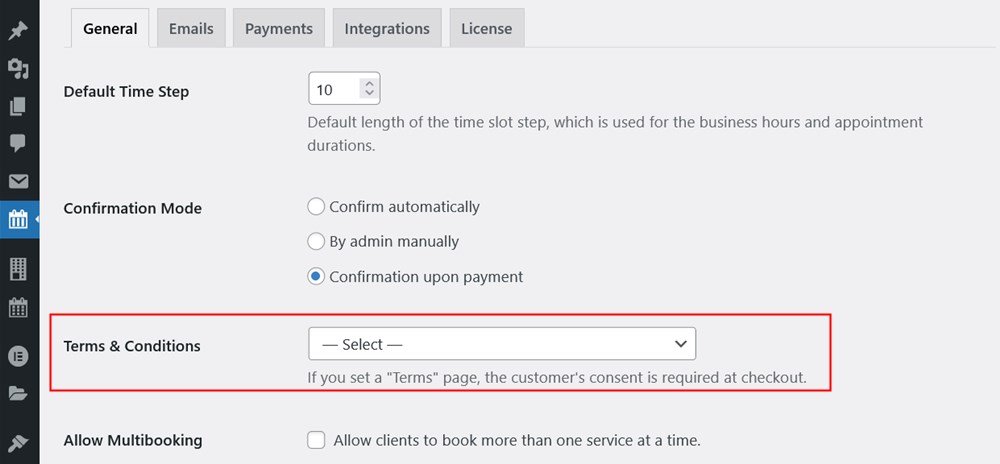
If I had to pick one place where guests absolutely should have access to your short term lease agreement terms, it would be before they confirm the booking.
With MotoPress Hotel Booking, you can create a dedicated Terms & Conditions page on your WordPress website and select it in the plugin settings. Guests are then asked to accept your terms as part of checkout.
Add the Agreement to Your Booking Emails
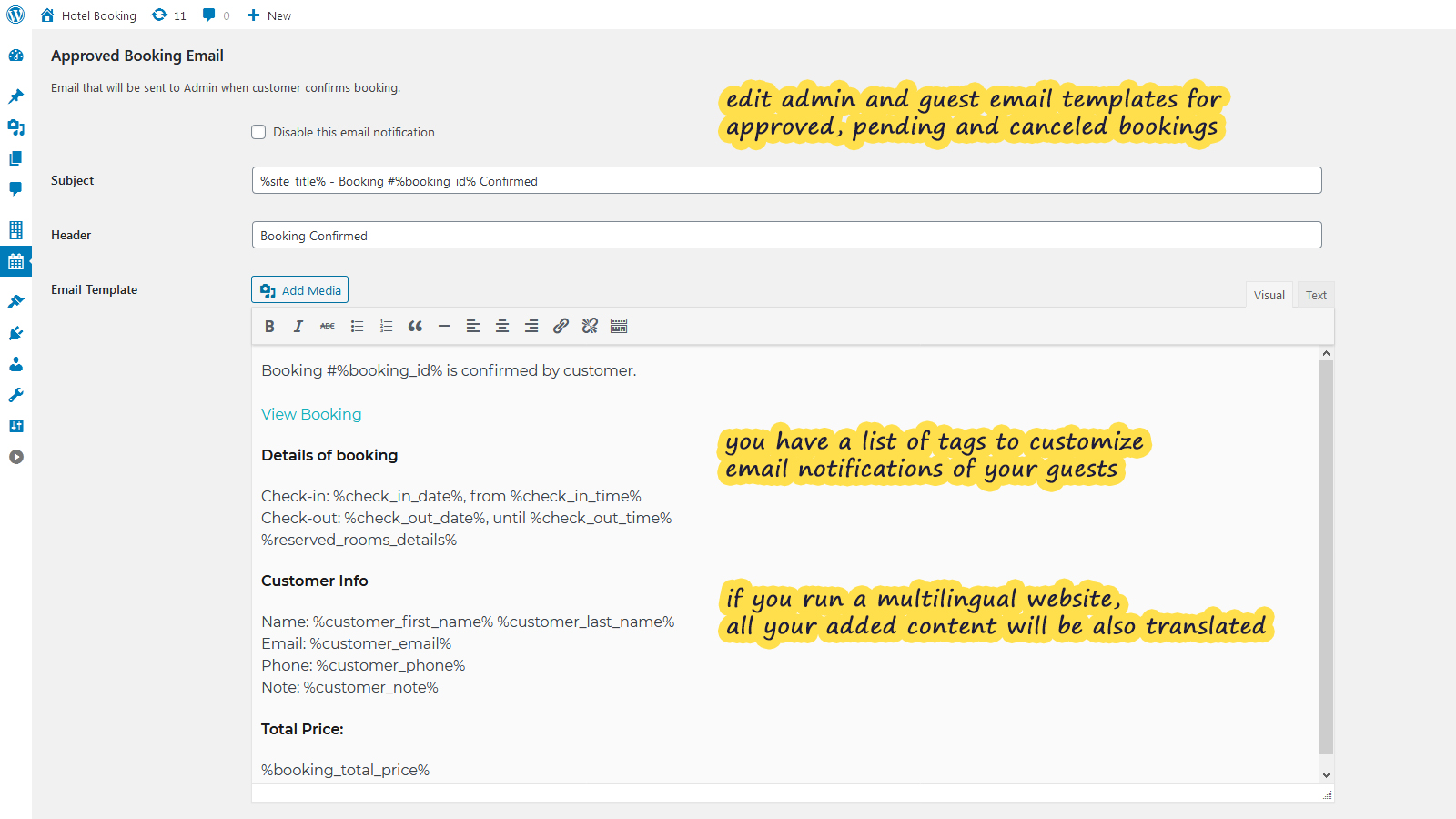
With MotoPress Hotel Booking, you’re not stuck with one-size-fits-all emails. You can edit the messages guests receive throughout the booking process and add the information that makes sense at each stage.
A simple option is to add a link to your vacation rental agreement page to the relevant guest email.
Take It a Step Further with MailChimp

MotoPress offers the Hotel Booking & Mailchimp Integration add-on. For our vacation rental agreement example, that might mean sending an email before arrival that links back to the agreement and highlights the few things guests should remember before they set off: check-in time, visitor rules, pet conditions, parking restrictions, or whatever matters at your property.
There are two separate pieces you’ll need for this setup:
- The Hotel Booking & Mailchimp Integration add-on.
- A Mailchimp account for creating and sending the emails. Mailchimp is a third-party service, so its own plan, features, limits, and pricing apply separately.
Hotel Booking + 9 Addons at Discounted Price
Bonus Tip: Instead of sending a wall of policy text, you might have a short “Before you arrive” email with a button leading to the complete rental terms.
A Few Short-Term Rental Agreement Mistakes Worth Avoiding

By now, your agreement should be in pretty good shape. Still, before you call it finished, there are a few easy-to-make mistakes worth checking for.
- Your final agreement should feel like it belongs to your rental but not like a general document you downloaded, added an address to, and called it a day.
- When the rental changes, the agreement should catch up. You don’t need to open your vacation rental agreement every Monday morning with your first cup of coffee. But I’d make a habit of reviewing it from time to time and whenever you make a meaningful change to your property or booking policies.
- Do a quick policy check across all the sources where it’s applied. Look at your property pages, booking form, rental agreement, automated emails, and any third-party listings you use (Booking.com, Airbnb, Tripadvisor, etc.).
One Last Thing Before You Use Your Agreement
The vacation rental agreement template in this guide can be a good place to start, and from there, you can adapt it to your rental. Add the rules that matter, make sure the payment and cancellation details are accurate, and so on.
It’s also worth thinking about where the agreement fits into the booking journey. That way, guests can see exactly what they’re agreeing to while they’re still making the reservation.
What’s the one rule or condition you’d never leave out of your vacation rental agreement template? Share it in the comments!
FAQ about Vacation Rental Agreements
Do I need a vacation rental agreement?
Can I create my own vacation rental agreement?
Does a vacation rental agreement need to be signed?
What is the difference between a vacation rental agreement and house rules?
Should Airbnb or Vrbo hosts have a separate rental agreement?